The Building Information Modeling (BIM) market continues to evolve as digital construction becomes more widely adopted across the architecture, engineering, and construction industry.
This statistical roundup covers the latest data on BIM market size, regional market share, adoption rates, technology trends, deployment models, end users, and projected growth.
Whether you’re researching the BIM market or evaluating industry trends, these statistics provide a comprehensive snapshot of the global BIM ecosystem. We’ve also included the links to the original data sources at the end for further reference.
Key BIM Statistics at a Glance
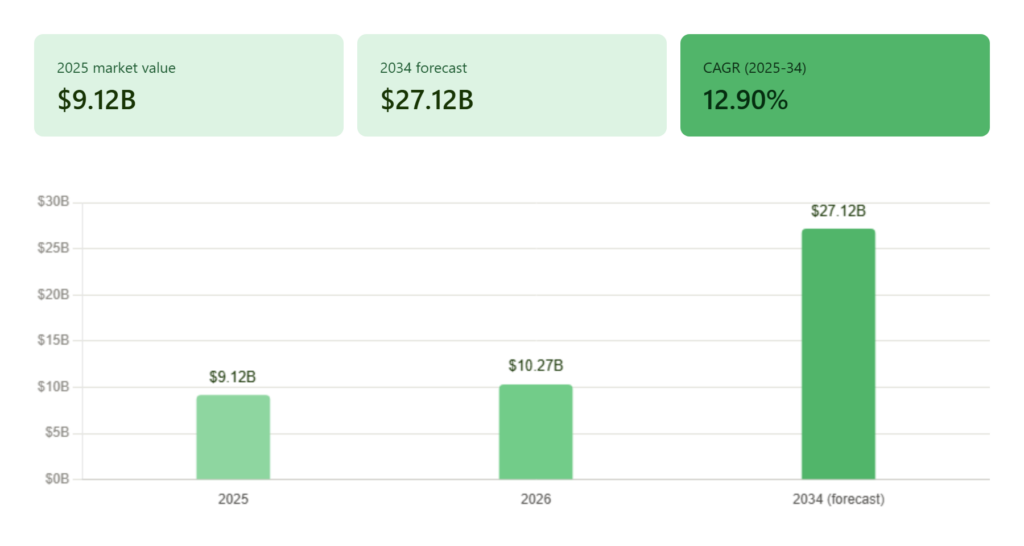
- The global Building Information Modeling (BIM) market was valued at USD 9.12 billion in 2025 and is projected to reach USD 27.12 billion by 2034, growing at a CAGR of 12.90%.
- North America was the largest BIM market in 2025, accounting for 35.60% of global revenue.
- The Asia Pacific BIM market is projected to grow at the fastest rate, with a CAGR of more than 16.0% between 2025 and 2033.
- A 2023 global survey found that more than 300 construction projects across eight countries were using BIM technology.
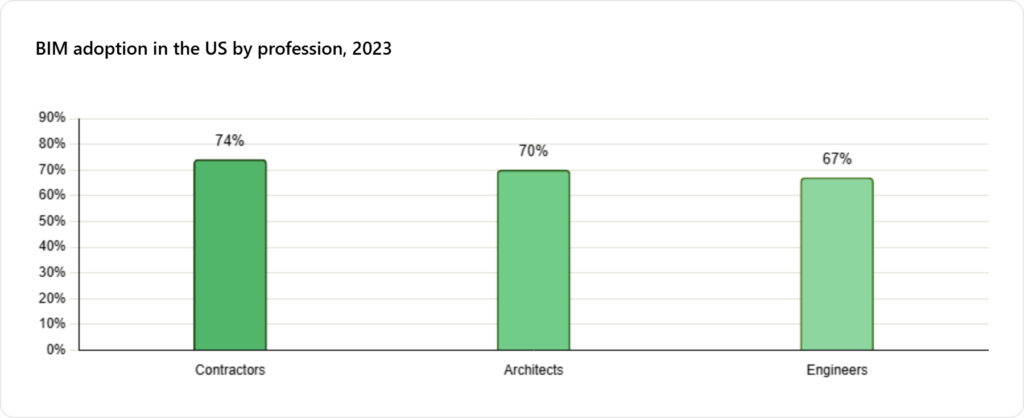
- In the United States, 74% of contractors, 67% of engineers, and 70% of architects used BIM on projects in 2023.
- AI-driven BIM solutions are expected to account for 40.21% of the global market in 2026 and grow at a CAGR of 16.80%.
- 5D BIM (cost estimation) is projected to be the fastest-growing BIM solution, with a 18.80% CAGR during the forecast period.
- The software segment accounted for more than 66% of the global BIM market in 2024, making it the largest segment.
- The government and public sector segment is projected to grow at a 17.20% CAGR, making it the fastest-growing end-user segment.
- According to NITI Aayog, implementing BIM can reduce construction time and lower project costs by 20%.
How big is the global BIM market?
The global Building Information Modeling (BIM) market was valued at USD 9.12 billion in 2025 and is expected to reach USD 27.12 billion by 2034, growing at a CAGR of 12.90%. The market is projected to increase from USD 10.27 billion in 2026, reflecting strong demand for digital construction technologies worldwide.
The market continues to expand as governments mandate BIM for public infrastructure projects and construction companies invest in AI, cloud computing, and digital collaboration tools.
Which regions lead the global BIM market?
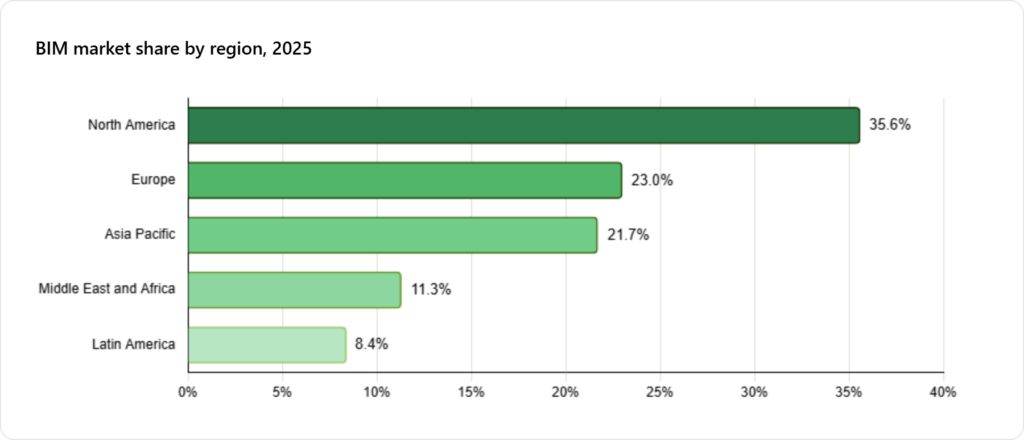
North America accounted for the largest share of the global BIM market in 2025, representing 35.60% of total revenue.
Europe accounted for 23.00% of the global market, followed by Asia Pacific at 21.70%. The Middle East and Africa accounted for 11.30%, while Latin America represented 8.40% of the global BIM market.
In North America, the United States generated more than 66% of the region’s BIM market revenue in 2024.
Which regions are expected to grow the fastest?
Asia Pacific is projected to be the fastest-growing regional BIM market, with a CAGR of more than 16.0% from 2025 to 2033. During the same period, the European BIM market is expected to grow at a CAGR of over 10.0%, driven by increasing adoption of BIM in public infrastructure and transportation projects.
How widely is BIM used across the construction industry?
BIM adoption has become widespread among architects, engineers, contractors, and governments. Usage continues to rise as organizations seek better project coordination, lower costs, and improved construction efficiency.
Global and regional adoption statistics include:
- More than 300 projects across the United Kingdom, the United States, Germany, France, China, Japan, Korea, and Singapore used BIM in 2023.
- Malaysia’s Public Works Department implemented BIM in 455 projects between 2021 and 2024.
- In the United States, 74% of contractors, 67% of engineers, and 70% of architects used BIM in 2023.
- Major U.S. contractors reported 80%-90% BIM usage on major infrastructure and commercial projects in 2024.
- More than 12,000 firms across the United States are registered BIM users.
- 62% of top-tier U.S. contractors are registered BIM users.
- Approximately 23% of firms reported using BIM across all of their projects.
- BIM adoption reached 52% of new building projects in Europe.
- 27% of large urban infrastructure projects in the Middle East and Africa use BIM.
- 61% of Gulf region megaprojects require BIM.
Which BIM technologies and solutions are growing the fastest?
AI, cloud computing, digital twins, IoT, and advanced BIM workflows are accelerating the next phase of BIM adoption. AI-driven solutions and 5D BIM are expected to experience the strongest growth.
Key technology statistics include:
- AI-driven BIM solutions are expected to account for 40.21% of the market in 2026.
- AI-driven BIM solutions are projected to grow at a CAGR of 16.80% in the upcoming years.
- The 3D modeling and visualization segment is expected to account for 28.13% of the market in 2026.
- 5D BIM (cost estimation) is projected to grow at the highest CAGR of 18.80%.
- Among projects worth more than USD 100 million, 57% use 4D scheduling, while 39% use 5D cost estimation modules.
- AI, cloud computing, digital twins, IoT, and 4D and 5D BIM are among the biggest technologies driving BIM adoption.
Which BIM deployment models are most popular?
On-premises deployment continues to hold the largest market share, although cloud-based BIM platforms are expanding rapidly, especially in Asia Pacific.
- On-premises deployment accounted for 52.3% of the BIM market in 2022.
- 41% of new BIM deployments in Asia Pacific use cloud-based platforms.
- Mobile BIM usage in Asia Pacific increased from 31% to 52% over the last three years.
Which BIM components have the largest market share?
Software remains the largest component of the BIM market because organizations continue to invest in modeling, collaboration, and project management platforms.
- The software segment held more than 66% of the BIM market in 2024.
- The designing application segment accounted for more than 42% of the market in 2024.
Which industries, professionals, and building types drive BIM demand?
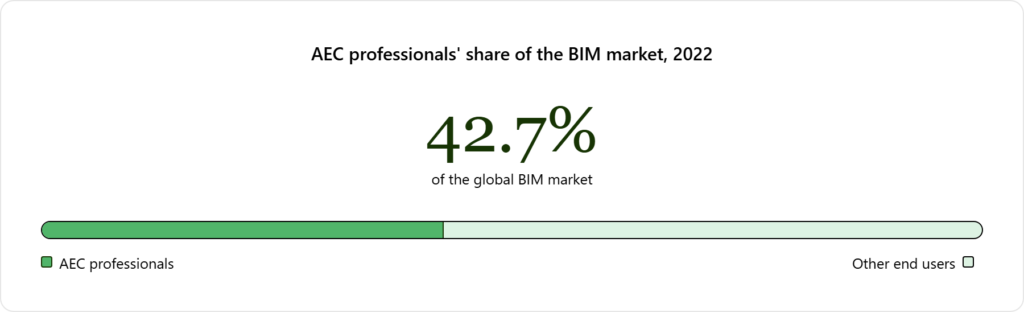
AEC professionals remain the largest end-user group, while government organizations, contractors, engineers, and non-residential construction continue to drive market growth.
- AEC professionals accounted for 42.7% of the BIM market in 2022.
- The government and public sector segment is projected to grow at a CAGR of 17.20%.
- The builders and contractors segment is projected to grow at a CAGR of 16.70%.
- The engineers segment is the largest contributor to the market and is expected to grow at a 14.5% CAGR.
- The non-residential building segment holds the largest market share and is expected to grow at a CAGR of 14.8%.
- The residential building segment is expected to record the fastest growth, with a CAGR of 13.6%.
What are the main benefits of using BIM?
According to NITI Aayog, implementing Building Information Modeling (BIM) can reduce construction time and lower overall project costs by 20%. These benefits make BIM an effective technology for improving construction project planning and execution.
Explore More Insights:
- 50+ AI in Interior Design Statistics 2026: Trends and Growth
- 75+ Smart Home Statistics Covering Trends and Usage 2026
- 50+ Architecture Statistics You Should Know in 2026
Final words
Building Information Modeling (BIM) is becoming a standard part of modern construction, with growing adoption across regions, industries, and project types. As demand for BIM professionals continues to increase, learning tools such as Autodesk Revit and practical BIM workflows can provide a valuable career advantage.
If you’re looking to build job-ready BIM skills, ASDAV’s Professional Revit & BIM Course for Interior Designers offers live training, real-world projects, and hands-on experience designed specifically for interior design professionals.
👉 Ready to learn BIM? Talk with ASDAV experts today.
Data Sources
- https://www.fortunebusinessinsights.com/building-information-modelling-software-market-102986
- https://www.grandviewresearch.com/industry-analysis/building-information-modeling-bim-market
- https://www.sphericalinsights.com/reports/building-information-modeling-market
- https://www.icis.org/wp-content/uploads/2025/05/BIM-Education-Global-2025-Update-Report-V12.0.pdf
- https://www.360researchreports.com/market-reports/building-information-modelling-market-208618
- https://straitsresearch.com/report/bim-in-construction-market

Asmita Khodankar is an Architect, Design Photographer, and the Founder of Shades Studio by Asmita, bringing over 7 years of experience at the intersection of architecture, interiors, and visual storytelling. Having successfully delivered 500+ projects, she has built a reputation for capturing spaces with authenticity, precision, and an eye for design.
Her work has been featured in renowned international publications, including GoodHomes, ELLE DECOR, and other leading design magazines, reflecting her commitment to creating imagery that celebrates thoughtful architecture and interiors. Over the years, she has collaborated with 50+ clients, ranging from independent architects and interior designers to established legacy brands such as Duroply.
Through her writing, Asmita shares practical insights on architecture, interior design, design photography, and the creative process, helping professionals and enthusiasts alike understand the finer details that transform spaces into meaningful experiences.