Smart home technology continues to change how people manage security, lighting, entertainment, appliances, and energy use inside their homes. More households now rely on connected devices to improve convenience, safety, and automation in daily life.
Recent reports show strong growth in smart home spending, device shipments, and user adoption worldwide. Smart speakers, security cameras, lighting systems, and connected appliances remain some of the most widely used smart home products.
This article covers the latest smart home statistics for 2026, including market size forecasts, consumer adoption trends, device usage patterns, regional growth, connectivity trends, and future industry predictions from leading research firms.
All the smart home statistics shared in this article are carefully curated from industry reports, market research studies, technology platforms, and trusted analytics sources. For better transparency and further reading, we have listed all reference sources at the end of the article.
Key Smart Home Statistics at a Glance
- The global smart home market could reach between USD 164 billion and USD 180 billion in 2026.
- Fortune Business Insights predicts that the smart home industry may grow to nearly USD 848 billion by 2034.
- Global smart home device shipments are expected to approach 1.25 billion units in 2026.
- Around 77 million homes in the United States already use smart home devices.
- Smart speakers are installed in nearly 79% of smart enabled households worldwide.
- Smart entertainment devices account for almost 30% of the global smart home device market.
- North America held more than 36% of the global smart home market share in 2025.
- Asia Pacific is projected to grow at a CAGR of more than 17% through 2031, making it the fastest growing region.
- India’s home automation market is expected to grow at a CAGR of nearly 29.8% through 2026.
- Online platforms generated more than 62% of global smart home sales revenue in 2025.
Global Smart Home Market Statistics
The smart home industry continues to grow as more households adopt connected devices and automation systems. Market reports show strong demand for smart security, entertainment, lighting, and home control solutions worldwide.
Rising internet access, IoT adoption, and AI integration continue to support market expansion across major regions.
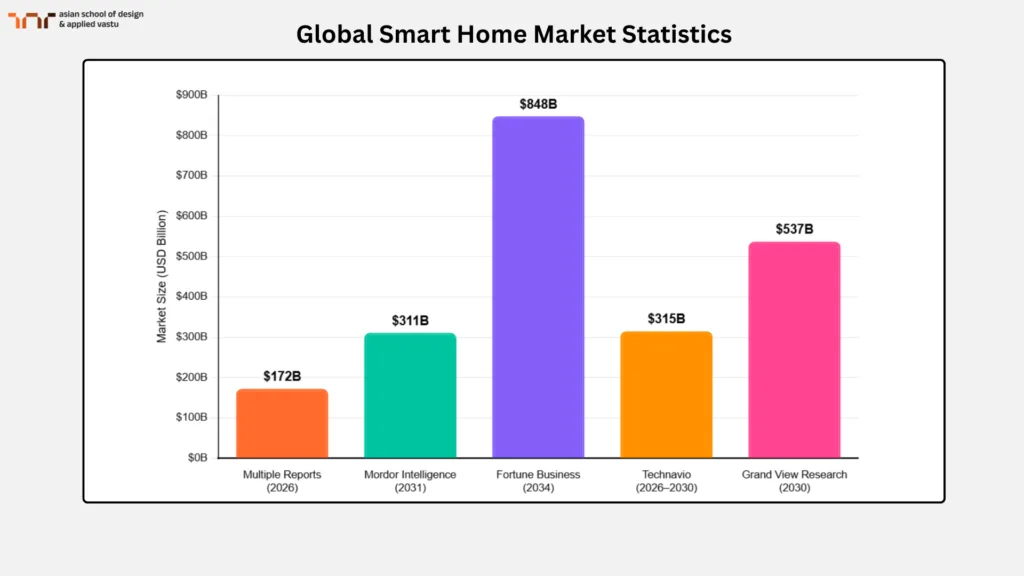
- Multiple industry reports estimate that the global smart home market could reach between USD 164 billion and USD 180 billion in 2026, showing continued growth in consumer spending on connected home technologies.
- Mordor Intelligence projects that the global smart home market may grow to USD 311.22 billion by 2031 while maintaining a CAGR of 13.65% during the forecast period.
- Fortune Business Insights expects the smart home industry to expand significantly and reach nearly USD 848.47 billion by 2034, supported by growing demand for automation and AI enabled devices.
- Technavio predicts that the smart home market could add more than USD 315 billion in new growth between 2026 and 2030, with a projected CAGR of 24.1%.
- Grand View Research estimates that the global smart home market may surpass USD 537 billion by 2030 as smart devices become more common in everyday households.
- Industry forecasts suggest that worldwide smart home device shipments could approach 1.25 billion units in 2026 due to rising adoption of connected products.
- Reports indicate that the number of active smart home households globally may reach between 93 million and 100 million by 2027.
- North America accounted for more than 36% of the global smart home market in 2025, making it the leading regional contributor to industry revenue.
- Asia Pacific is expected to record the fastest market expansion through 2031, with projected annual growth of more than 17% during the forecast period.
Smart Home Device and Product Statistics
Smart speakers, security systems, and connected entertainment products continue to lead the smart home market. Consumers now invest more in devices that improve convenience, safety, and home automation. Market data also shows growing demand for smart appliances and energy management systems across households worldwide.
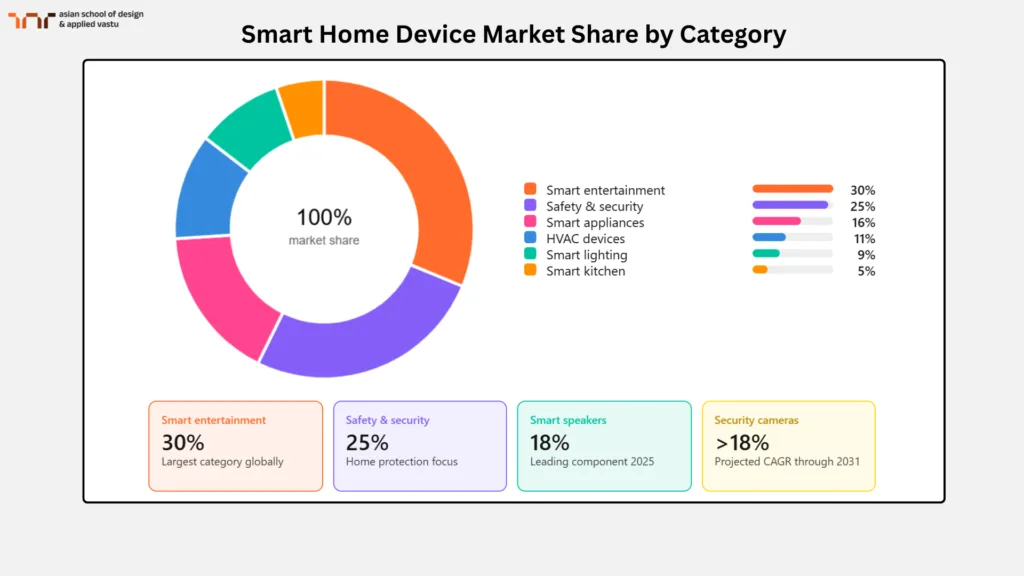
- Smart entertainment products held the largest share of the smart home device market, contributing nearly 30% of total market revenue globally.
- Safety and security devices accounted for around 25% of the global smart home market as more users focused on home protection solutions.
- Smart home appliances represented about 16% of the market, showing strong consumer interest in connected household products.
- HVAC related smart devices contributed nearly 11% of total smart home market share worldwide.
- Smart lighting systems captured close to 9% of the global smart home device market.
- Smart kitchen appliances made up around 5% of the market as connected cooking and kitchen products gained popularity.
- Smart speakers remained the leading smart home component category in 2025, accounting for more than 18% of the market.
- Industry forecasts show that smart security cameras could grow at an annual rate of over 18% through 2031 due to rising security concerns.
- Research shows that nearly 45% of households already own smart entertainment devices, making them one of the most widely adopted smart home products.
Consumer Adoption and Usage Statistics
Smart home devices have become more common as consumers look for better convenience, security, and remote control features. Products such as smart speakers, thermostats, and security systems continue to see steady adoption across households. Usage trends also show that entertainment and safety remain the main reasons behind smart home adoption.
- More than 77 million homes in the United States actively use smart home devices, showing strong adoption across residential households.
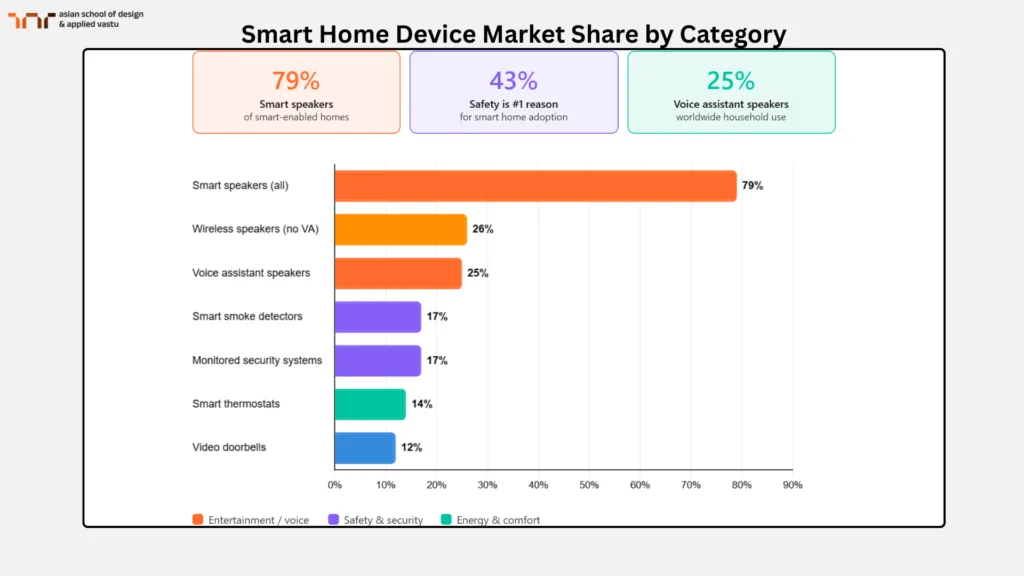
- Research shows that nearly 79% of smart enabled households have installed smart speakers for voice control and automation.
- Around 26% of households use wireless smart speakers that do not include built in voice assistants.
- Smart speakers with voice assistant features are now used by nearly 25% of households worldwide.
- About 17% of households have installed smart smoke detectors to improve home safety and emergency monitoring.
- Another 17% of households use monitored smart security systems for home surveillance and protection.
- Smart thermostats are currently used in nearly 14% of households to help improve temperature control and energy management.
- Video doorbells have reached around 12% household adoption as more consumers invest in connected security devices.
- Around 43% of smart home users say safety and security are the main reasons they adopt connected home technologies.
Demographic and User Behaviour Statistics
Smart home adoption rates continue to vary across different age groups and consumer segments. Younger consumers show stronger interest in connected living technologies, while older generations adopt smart devices at a slower pace. User behaviour data also highlights growing interest in security, convenience, and energy savings.
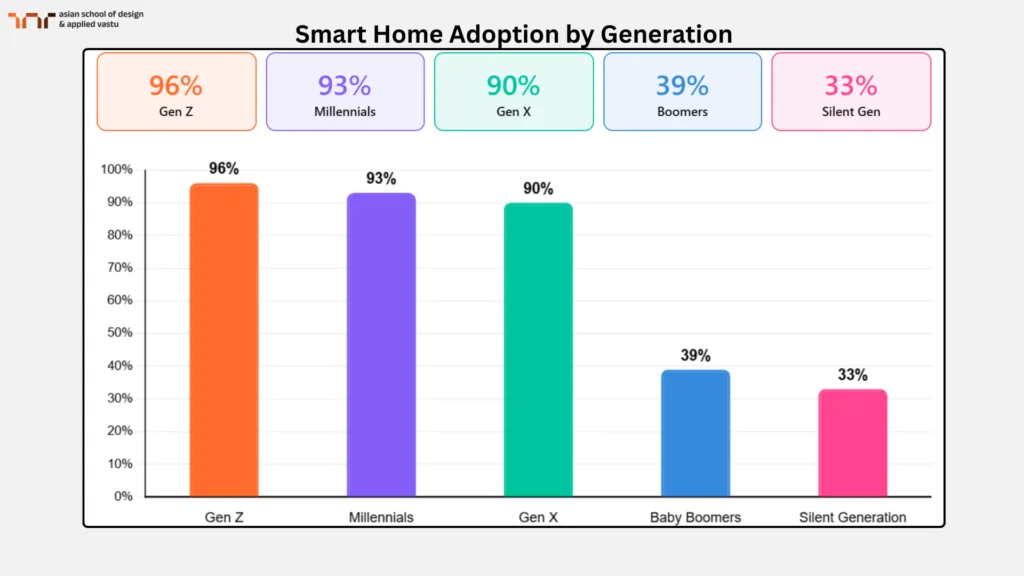
- Gen Z currently records one of the highest smart device adoption rates in the United States, reaching nearly 96%.
- Around 93% of millennials already use at least one smart device, making them one of the largest consumer groups in the market.
- Nearly 90% of Gen X consumers have adopted at least one smart home device inside their homes.
- Around 39% of Baby Boomers currently use smart home devices in their households.
- Nearly 33% of the Silent Generation has adopted at least one smart device despite lower overall technology adoption rates.
- Only about 24% of people aged 55 and older currently own smart home devices.
- In the United States, nearly 57% of individuals above the age of 55 show little interest in adding smart gadgets to their homes.
- Research shows that around 21% of households with consumers aged between 18 and 49 own smart speakers.
- About 36% of adults between the ages of 35 and 54 consider security cameras their preferred option for home protection.
- Among women aged 25 to 34, nearly 14% prefer automatic smart locks for improving home security.
- Around 17% of men and 13% of women use smart home devices mainly to lower utility and energy costs.
Regional Smart Home Market Statistics
Smart home adoption continues to grow across major global regions as consumers invest more in connected living technologies. North America remains the largest regional market, while the Asia Pacific continues to record the fastest growth rates. Europe, the Middle East, and Latin America are also expanding steadily due to rising internet access and smart device adoption.
- The North American smart home market reached nearly USD 46.8 billion in 2025 as demand for connected devices continued to rise.
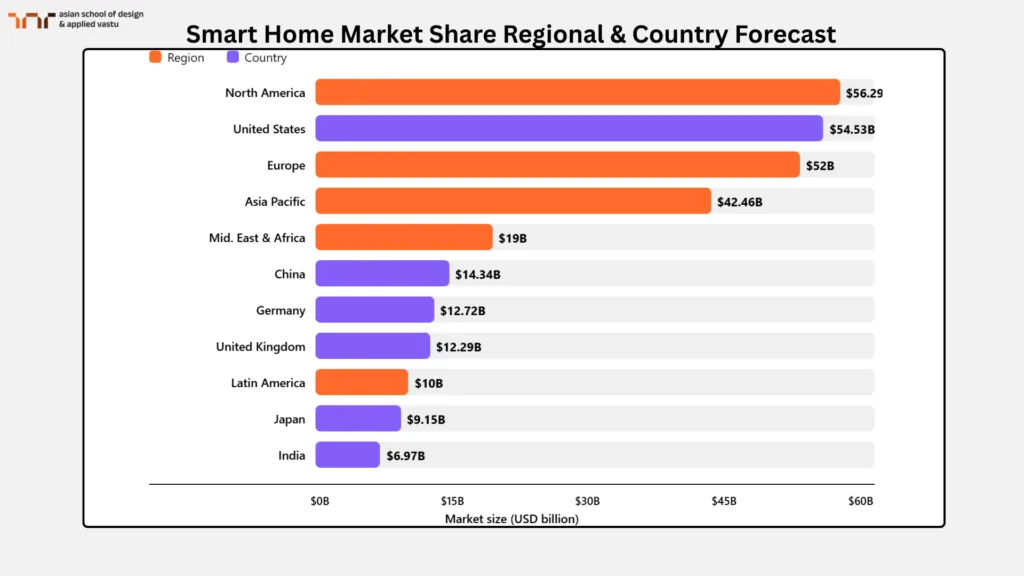
- Industry forecasts estimate that the North American market could grow to around USD 56.29 billion in 2026.
- The United States alone is expected to generate more than USD 35 billion in smart home market revenue during 2026.
- Europe accounted for almost 29% of the global smart home market in 2025, making it one of the largest regional contributors.
- Market estimates show that Europe’s smart home industry could reach nearly USD 52 billion in 2026.
- The Asia Pacific smart home market reached approximately USD 34.2 billion in 2025 due to rising adoption across developing economies.
- Forecasts suggest that the Asia Pacific region may grow to around USD 42.46 billion in 2026.
- The smart home market across the Middle East and Africa is expected to reach nearly USD 19 billion in 2026.
- Latin America could generate more than USD 10 billion in smart home market revenue by 2026.
Country-Specific Smart Home Statistics
Several countries continue to invest heavily in smart home technologies as internet access, urban development, and connected living trends increase worldwide. The United States remains one of the largest smart home markets, while countries such as China and India continue to see rapid growth. Market forecasts also show rising adoption across Europe and Asia.
| Country | Projected Smart Home Market Size in 2026 |
| United States | USD 54.53 Billion |
| China | USD 14.34 Billion |
| Germany | USD 12.72 Billion |
| United Kingdom | USD 12.29 Billion |
| Japan | USD 9.15 Billion |
| India | USD 6.97 Billion |
Smart Home Infrastructure and Connectivity Statistics
Internet connectivity and wireless technologies continue to play a major role in smart home growth worldwide. Faster broadband access, expanding 5G coverage, and improved wireless infrastructure help connected devices work more efficiently across households. Market trends also show that online platforms remain the leading sales channel for smart home products.
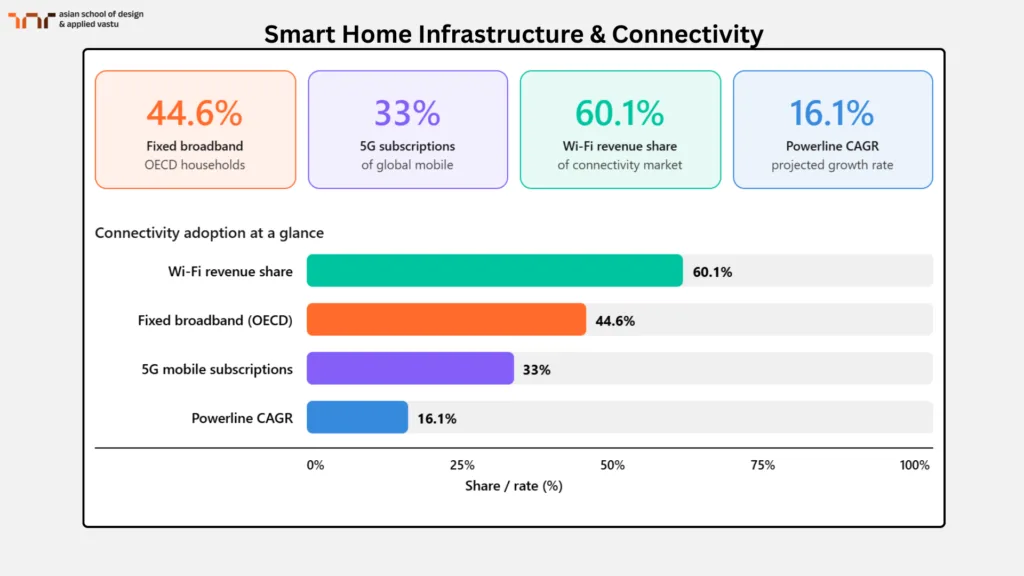
- Fixed broadband connections reached nearly 44.6% of households across OECD countries by the end of 2024.
- Around 33% of global mobile subscriptions now operate on 5G networks, supporting faster and lower latency smart home connectivity.
- Wi Fi powered systems generated 60.12% of smart home connectivity revenue during 2025 because most households already rely on wireless internet networks.
- Powerline and PLC based smart home technologies are expected to grow at a CAGR of 16.12% through 2031 as consumers look for alternative connectivity solutions.
- Fixed wireless access connections increased by nearly 17% year over year as more regions gained access to high speed internet services.
Smart Home Installation and Housing Statistics
Housing type and installation methods continue to shape smart home adoption worldwide. Single family homes currently dominate installations, while retrofit projects continue to grow across existing residential properties. Market forecasts also show rising demand for smart upgrades in multi family housing developments.
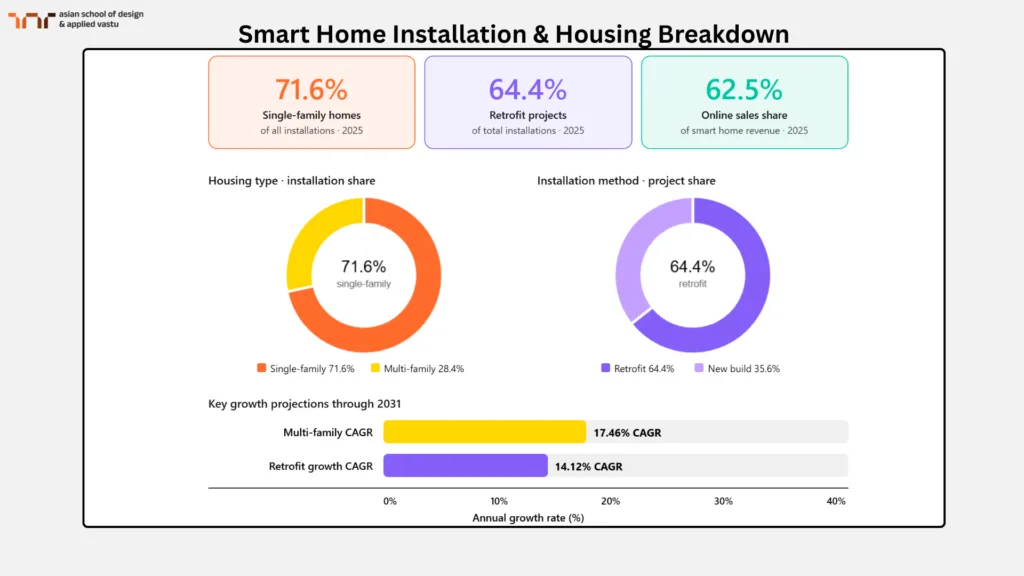
- Single family homes accounted for 71.63% of global smart home installations in 2025, making them the leading housing segment for connected technology adoption.
- Multi family housing installations are projected to grow at a CAGR of 17.46% through 2031 due to increasing urban residential development.
- Retrofit projects represented 64.36% of total smart home installations worldwide during 2025.
- Industry forecasts estimate that retrofit smart home projects could expand at an annual growth rate of 14.12% through 2031.
- Existing housing stock in mature markets outnumbers new residential construction by nearly 50 to 1, which continues to support retrofit demand.
- Online sales platforms captured 62.52% of smart home revenue in 2025, helping increase access to retrofit installation products and services.
Explore More Insights
- 30+ Interior Design Statistics That Matter in 2026
- 🌐 130+ Interesting eLearning Statistics For 2026
- 50+ Architecture Statistics You Should Know in 2026
Build Smart Interior Design and Space Planning Skills With ASDAV
The smart home industry continues to grow rapidly as more consumers adopt connected technologies for security, automation, comfort, and energy management. Market forecasts show strong long term demand for smart devices, home automation systems, and AI powered living solutions across global markets. As technology adoption increases, the demand for skilled professionals in interior design, smart space planning, architecture, and modern residential design is also rising.
For learners who want to build practical skills in modern interior design, architecture, Vastu, and BIM workflows, ASDAV offers industry focused training designed around real world applications. ASDAV provides live instructor led programs that help students, professionals, homemakers, and career switchers develop practical design knowledge that can be applied in projects, freelance work, and professional careers.
The school offers specialized courses in residential and commercial interior design, applied Vastu, and Revit architecture with hands on software training in tools such as AutoCAD, SketchUp, Lumion, Enscape, and Revit. ASDAV focuses on skill based learning, practical workflows, and live project understanding instead of theory heavy education.
To learn more about ASDAV’s design programs and live training sessions, visit ASDAV Official Website
Data Sources
- https://www.statista.com/outlook/cmo/smart-home/worldwide
- https://www.mordorintelligence.com/industry-reports/global-smart-homes-market-industry
- https://www.fortunebusinessinsights.com/industry-reports/smart-home-market-101900
- https://scoop.market.us/smart-home-statistics/
- https://market.us/report/smart-homes-market/
- https://sqmagazine.co.uk/smart-home-statistics/
- https://www.makerstations.io/smart-home-market-trends/
- https://www.marketsandmarkets.com/Market-Reports/smart-homes-and-assisted-living-advanced-technologie-and-global-market-121.html

Jasmine Ahluwalia is a Licensed Architect, Interior designer, Global Vastu consultant and the founder of ASDAV.
She is a graduate of Scuola Master F.lli Pesenti, Politecnico di Milano, and brings strong global exposure through academic learning and professional design projects. Her background combines architecture, interior design, and applied design education.
Before founding ASDAV, Jasmine worked as an assistant professor at Amity School of Architecture and Planning, Amity University Noida. Her research covers sustainable architecture, urban heat island reduction, and circular economy practices in construction. Her work has been published in Scopus indexed and peer reviewed journals as well. She also has strong international on-site experience from countries like Canada, Mauritius, UK, and many more.
Through ASDAV, she has trained more than 500 students across 25 cities. The ASDAV platform has 12+ instructors from IIT, SPA, CEPT and NID , and has delivered over 200 live learning sessions. Her mission is to bridge the gap between design education and real industry expectations, to deliver real growth for her students.
She designs spaces for a living, but her favourite project is designing careers.