Artificial Intelligence is changing the way we design spaces. Today, ChatGPT can suggest room layouts in seconds, Midjourney can create stunning interior concepts from a simple prompt, and AI tools can generate floor plans almost instantly. When you see these capabilities, it is natural to wonder if interior designers and architects will still be needed in the future.
So, does this mean interior designers and architects are becoming obsolete?
The short answer is No.
The longer answer is much more interesting.
AI is making design faster and helping professionals explore ideas more efficiently, but designing a real home, office, retail store, or commercial building involves much more than creating attractive images. Every project has unique client requirements, site conditions, budgets, regulations, materials, and construction challenges that require human expertise and decision-making.
In this guide, we’ll look at what AI can actually do today, where it still falls short, how the design industry is adapting, and why the future belongs to professionals who know how to combine creativity, technical knowledge, and AI instead of competing with it.
Why Is This Question Everywhere in 2026?
Ever since ChatGPT was launched, people have questioned whether AI would replace human jobs. First, the discussion centred around content writers. Then AI image generators, video tools, coding assistants, and other creative technologies became mainstream. Today, social media platforms like Instagram, TikTok, and YouTube are filled with viral AI-generated home interiors, luxury villas, and futuristic buildings that look incredibly realistic.
At the same time, architecture and design firms across the world are experimenting with AI to speed up concept development, visualisation, and documentation. Reports from organisations like Goldman Sachs have also suggested that architecture and engineering could see around 37% task exposure to AI automation, making many students and professionals wonder if their careers are at risk.
It sounds alarming, but task exposure is not the same as job replacement.
Interior design and architecture are not just about creating beautiful images. They involve understanding people, solving real-world problems, working within budgets, coordinating with contractors, following building regulations, and ensuring designs can actually be built. AI can assist with many tasks, but it still cannot replace the expertise required to turn a concept into a functional, safe, and liveable space.
What AI Can Already Do Today
AI is no longer a futuristic technology. Today, it helps designers and architects work faster, explore more ideas, and improve productivity. Here are some of the most practical things AI can already do.
AI Can Generate Concepts in Seconds
One of the biggest advantages of AI is how quickly it can turn an idea into a visual concept. What once took hours of searching, sketching, and creating presentation boards can now be done in minutes, making early-stage client discussions much faster.
AI can instantly generate:
- Mood boards
- Colour palettes
- Furniture suggestions
- Multiple room styles for the same space
- Exterior design concepts
- Lighting ideas
- Material combinations
- Wall and ceiling treatments
- Landscape concepts
- Kitchen and bathroom layouts
- Seasonal décor variations
- Style combinations such as Japandi, Industrial, Scandinavian, or Contemporary
Instead of spending days preparing the first concept, designers can explore multiple directions with clients in a single meeting.
AI Speeds Up Repetitive Work
AI delivers the biggest productivity gains by reducing repetitive tasks rather than replacing creative decision-making. It allows designers and architects to spend less time on routine work and more time refining designs and solving client problems.
Today, AI can assist with:
- Client presentations and presentation copy
- Material research and product comparisons
- Preliminary cost estimation
- Furniture and fixture recommendations
- Design documentation
- Meeting notes and project summaries
- Building code and regulation research
- Specification drafting
- Email communication
- Rendering enhancements
- Design alternatives based on client feedback
Many firms now use AI as a daily productivity assistant rather than a standalone design tool.
AI Is Becoming a Powerful Assistant Inside Design Software
AI is no longer limited to tools like ChatGPT or Midjourney. The software used by architects and interior designers is also becoming AI-enabled.
Leading platforms now offer AI-powered capabilities, including:
- Autodesk AI for generative design and project insights
- Autodesk Forma for early-stage site analysis and planning
- Revit AI features for model assistance and workflow optimisation
- SketchUp AI extensions for concept generation
- Rhino + Grasshopper AI integrations for parametric design
- Adobe Firefly for quick material and presentation visuals
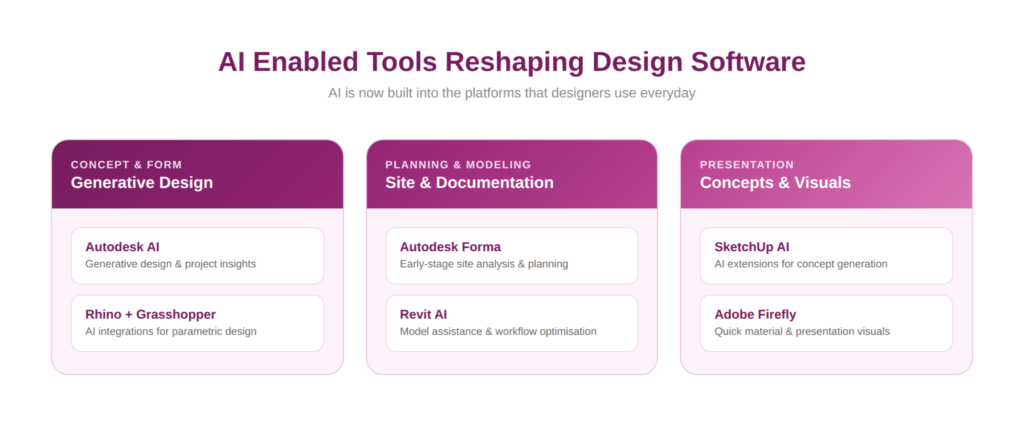
Instead of replacing existing workflows, these tools help professionals explore more design options, automate repetitive modelling tasks, and make faster design decisions while continuing to work inside familiar software environments.
Automated BOQs, Material Takeoffs, and Layout Permutations
Many tasks that previously required manual calculations are now being partially automated using AI and BIM workflows.
These include:
- Automatic Bill of Quantities (BOQs)
- Material takeoffs directly from BIM models
- Quantity extraction from 2D and 3D drawings
- Multiple space planning and layout permutations
- Clash detection between architectural, structural, and MEP models
- Early-stage construction cost comparisons
For example, Autodesk’s connected takeoff workflows have helped firms reduce quantity takeoff time by over 50% while also improving estimating accuracy by using BIM data directly instead of manual measurements.
BIM and AI-Assisted Planning Are Becoming Standard Across Global Firms
Across India, the UAE, the UK, and other mature construction markets, AI is increasingly being integrated into BIM workflows rather than used as a separate technology.
Examples include:
- India: Large organisations such as Adani Group and Shapoorji Pallonji are expanding the use of Autodesk Construction Cloud and BIM-based digital workflows to reduce manual reporting, improve collaboration, and create a single source of project data.
- UAE: Many leading engineering consultancies now use AI-assisted clash detection, digital twins, automated coordination, and cloud-based BIM platforms to deliver large-scale projects while meeting authority requirements from Dubai Municipality and Abu Dhabi agencies.
- UK: BIM has been embedded across major public and private projects for years, and firms are now adding AI for generative design, project planning, scheduling, and risk analysis instead of treating it as a separate workflow.
The industry is clearly moving towards AI-assisted design. However, these technologies are enhancing professional workflows, not replacing the architects, interior designers, engineers, and project teams responsible for delivering real buildings.
What AI Still Cannot Do (And Why It Matters)
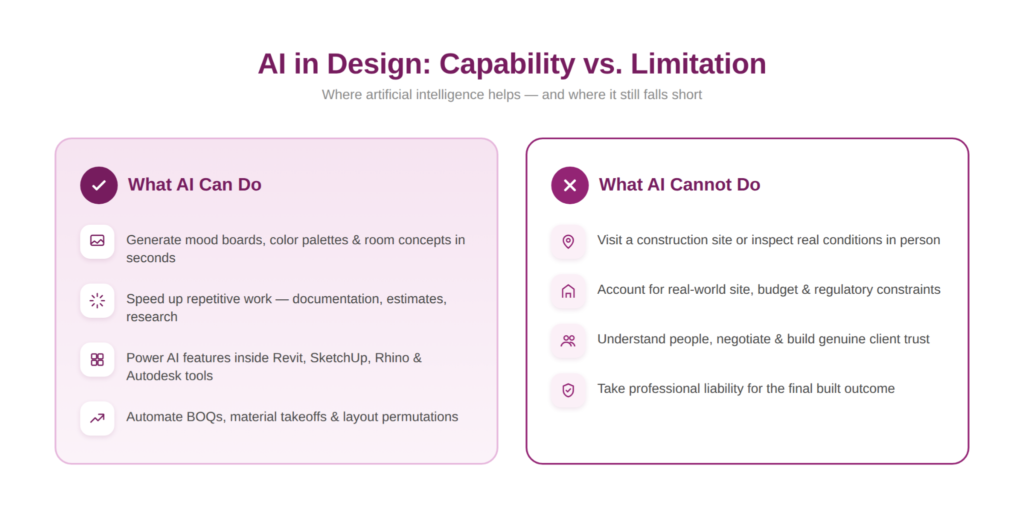
AI can assist with design, but it cannot take responsibility for a real project. Interior design and architecture involve people, construction, regulations, budgets, and countless site decisions that still require experienced professionals.
AI Cannot Visit a Construction Site
A design does not become reality by looking good on a screen. Every project changes the moment construction begins. Site measurements may differ from the drawings, an old column may appear after demolition, plumbing lines may clash with a new layout, or a ceiling beam may reduce the available height.
These are decisions that require someone to physically inspect the site, discuss solutions with contractors, and make practical adjustments without compromising safety or functionality.
An AI model has never walked through a half-finished apartment, inspected water seepage behind a wall, measured an uneven floor, or coordinated with a carpenter whose fabrication differs slightly from the drawings. Site execution remains one of the biggest reasons why interior designers and architects continue to play a critical role.
AI Doesn’t Understand Real-World Constraints
AI can generate attractive visuals, but it often misses the practical realities that shape every project.
A home in Mumbai faces different space constraints than a villa in Dubai. A commercial office in Bengaluru follows different fire safety requirements than one in London. Material availability, labour expertise, climate, building age, local authority approvals, and client expectations all influence the final design.
Then there are project-specific factors that rarely exist in AI training data, such as:
- Soil conditions affecting foundations
- Monsoon drainage and waterproofing requirements
- Existing plumbing and electrical limitations
- Structural beams that cannot be removed
- Retrofitting older buildings with outdated construction methods
- Availability of local materials within budget
- Local contractor capabilities
- Client preferences such as Vastu compliance or accessibility requirements
These are not design prompts. They are real-world constraints that experienced professionals solve every day.
Great Design Is Built Around People, Not Prompts
Interior design and architecture are as much about people as they are about spaces.
Clients often begin with one vision and change their minds several times during the project. Budgets evolve, family requirements change, businesses expand, and unexpected construction challenges appear. Designers must balance aesthetics, functionality, timelines, and costs while keeping everyone aligned.
They also spend significant time:
- Understanding how people actually use a space
- Explaining why certain ideas may not be practical
- Negotiating design changes with clients
- Coordinating with structural engineers, electricians, plumbers, and contractors
- Finding alternatives when products are unavailable
- Resolving on-site issues without delaying the project
These conversations, negotiations, and decisions rely on empathy, experience, and communication. They cannot be generated from a prompt.
AI Doesn’t Take Responsibility for the Final Outcome
Perhaps the biggest difference between AI and a licensed professional is accountability.
Architects and interior designers approve drawings, verify specifications, ensure compliance with building regulations, and take professional responsibility for the work delivered. If a structural element fails, a fire safety requirement is overlooked, or a costly construction error occurs, it is the professionals involved who are held accountable.
As Filipino architect and content creator Oliver Austria explained in one of his discussions on AI in architecture, the biggest factor AI cannot replace is liability. If a structure collapses, you cannot blame AI. The responsibility ultimately rests with the architect who signed and approved the project.
AI can generate ideas, recommend layouts, and automate repetitive tasks. It cannot accept legal responsibility, carry professional liability, or make the final judgement on whether a design is safe, compliant, and ready to be built.
What Industry Experts Are Actually Saying
There is a lot of discussion online about AI replacing designers and architects. But when you look at what experienced professionals are actually saying, a different picture emerges. Most agree that AI is becoming an important part of the design process, but they also believe that human expertise, judgement, and accountability remain essential.
American Institute of Architects (AIA)
The American Institute of Architects created an AI Task Force to understand how AI will shape the profession. Their message is clear. AI should handle repetitive and time-consuming tasks, but it should not replace professional judgement.
According to the AIA, architects do much more than produce drawings. They understand client needs, interpret site conditions, coordinate with engineers and consultants, ensure designs meet regulations, oversee construction, make ethical decisions, and take responsibility for the final outcome. Their conclusion is simple. As technology evolves, architecture remains a human-centred profession built on expertise and accountability.
Angie Wetzel, President and Principal Designer, InterLux Interiors
Interior designer Angie Wetzel believes AI is excellent at finding patterns and generating ideas, but it cannot develop personal taste or design judgement.
An AI tool can create hundreds of design options within minutes. Choosing the one that truly fits a client’s lifestyle, budget, and vision still requires an experienced designer. Good design is not about having more options. It is about knowing which option is right.
Dax Augustus Taday, Architect
Architect Dax Augustus Taday believes the biggest difference between AI and a licensed architect is responsibility.
He explains that AI has made early concept development and rendering much faster. However, when a project moves forward, the architect is the person who signs the drawings, accepts legal responsibility, and is accountable if something goes wrong. AI can support the process, but it cannot take ownership of the final design.
Paola Bagaforo, AI Specialist
AI specialist Paola Bagaforo encourages architects and interior designers to see AI as a productivity tool instead of a competitor.
According to her, AI is most valuable when it removes repetitive work and gives professionals more time to focus on creativity, problem-solving, and client communication. The important decisions should still be made by people with the right knowledge and experience.
The Common View Across the Industry
Although these experts come from different backgrounds, they all share a similar opinion. AI is here to stay, and it will automate many routine tasks. But the most important parts of interior design and architecture, including creative thinking, client relationships, technical judgement, and professional accountability, continue to depend on skilled human professionals.
You might also be interested:
- Top 10 Architecture Software Every Architect Should Know
- Top 10 Best Interior Design Software For Beginners
- Top 12 BIM Software Every Architect Should Know (2026 List)
Build a Career That Grows With AI, Not Against It
Interior design and architecture continue to be among the most exciting and fast-evolving career choices. As cities expand, homes become smarter, and commercial spaces become more experience-driven, the demand for skilled professionals continues to grow. AI is changing how designers and architects work, but it is not replacing the need for creativity, technical expertise, and real-world problem-solving.
The best way to prepare for the future is to learn from experienced professionals who can teach you both the fundamentals of design and how to use modern AI tools effectively. Understanding AI will help you work faster and smarter, but it is your knowledge, judgement, and practical skills that will define your career.
At the Asian School of Design & Applied Vastu (ASDAV), we offer industry-focused certification courses in Interior Design and Architecture with Revit & BIM. Our programmes combine practical learning, software training, and exposure to the latest technologies, helping you build the skills employers are looking for today.
If you’re ready to start a future-ready career in design, explore our courses, enrol today, and learn how to combine creativity with the modern technology stack shaping the industry.

Jasmine Ahluwalia is a Licensed Architect, Interior designer, Global Vastu consultant and the founder of ASDAV.
She is a graduate of Scuola Master F.lli Pesenti, Politecnico di Milano, and brings strong global exposure through academic learning and professional design projects. Her background combines architecture, interior design, and applied design education.
Before founding ASDAV, Jasmine worked as an assistant professor at Amity School of Architecture and Planning, Amity University Noida. Her research covers sustainable architecture, urban heat island reduction, and circular economy practices in construction. Her work has been published in Scopus indexed and peer reviewed journals as well. She also has strong international on-site experience from countries like Canada, Mauritius, UK, and many more.
Through ASDAV, she has trained more than 500 students across 25 cities. The ASDAV platform has 12+ instructors from IIT, SPA, CEPT and NID , and has delivered over 200 live learning sessions. Her mission is to bridge the gap between design education and real industry expectations, to deliver real growth for her students.
She designs spaces for a living, but her favourite project is designing careers.