Thousands of architects in India remain stuck in the ₹20,000 to ₹40,000 salary range for years. The problem is not a lack of jobs. The real challenge is that many architects are not developing the skills that employers are willing to pay a premium for.
While consulting architecture students and working professionals, our team often comes across the same questions: Why are some architects earning ₹1 lakh or more per month while others struggle to cross ₹30,000? What skills actually lead to better opportunities? Which career paths offer the fastest salary growth?
The good news is that moving from a ₹25,000 salary to ₹1 lakh per month is achievable for almost any architect. It requires a clear understanding of industry demand, the right technical skills, practical project knowledge, and a focused career strategy.
In this guide, we break down the exact skills, specializations, and career moves that can help architects significantly increase their earning potential and build a more rewarding career.
The Real Salary Landscape of Architects in India

To understand how architects can move from a ₹25,000 salary to ₹1 lakh or more per month, it is important to first understand the current salary landscape of the architecture industry in India. While there are exceptions, most architects tend to fall into one of the following salary brackets during different stages of their careers.
Freshers: The ₹15,000–₹30,000 Reality
For most architecture graduates in India, the starting salary typically falls between ₹15,000 and ₹30,000 per month. If you browse architecture job vacancies on platforms like LinkedIn, Naukri, and Indeed, you will find that this remains the most common salary range for freshers.
Here are some of the recent BIM opportunities published on naukri.com for freshers:

Your academic performance may have a small impact on your first job offer, especially if you are graduating from a well-known institution. However, after the initial hiring stage, employers pay far more attention to practical skills, software proficiency, project experience, and your ability to contribute to live projects.
The reality is simple. Two freshers with the same degree can have significantly different salary growth trajectories within just a few years based on the skills they develop outside college.
Mid-Level Architects: The ₹40,000–₹70,000 Ceiling
This is one of the most common salary brackets in the architecture industry. A large percentage of architects spend years within this range and often struggle to move beyond it.
One of the biggest misconceptions is that salary growth automatically follows years of experience. In reality, employers pay for the value you bring, not simply the number of years you have worked.
While interacting with architects and students, we regularly come across professionals with 5 to 8 years of experience who are still earning between ₹40,000 and ₹60,000 per month. In many cases, they have continued performing similar drafting, modeling, or coordination tasks without developing higher-value skills that firms are actively willing to pay more for.
This is often where career growth slows down and many architects feel stuck despite having considerable experience.
High-Earning Architects: ₹1 Lakh+ Per Month
Architects earning ₹1 lakh or more per month typically belong to a relatively smaller segment of the industry. They are usually specialists, project leaders, BIM professionals, consultants, or architects managing high-value projects rather than only producing drawings.
The interesting part is that many of these professionals are not necessarily 15 to 20 years into their careers. In several cases, architects who develop specialized BIM, project management, coordination, and technical documentation skills reach the ₹12-20 LPA range within 5 to 10 years of experience.
A recent architectural salary analysis done by our team shows BIM Managers in India commonly earning ₹12-20 LPA, while BIM Consultants and Project Leads can earn ₹15-25 LPA or more.
Some of the most common characteristics of architects earning ₹1 lakh+ per month include:
- Strong BIM and Revit expertise
- Experience managing large-scale projects
- Ability to coordinate with multiple consultants and stakeholders
- Advanced project documentation skills
- Strong understanding of construction and site execution
- Leadership and team management capabilities
- Expertise in healthcare, commercial, hospitality, or large residential projects
- High-quality portfolio with measurable project outcomes
- Client-facing communication and presentation skills
- Experience working with international standards and workflows
- Ability to solve technical and coordination challenges independently
- Continuous investment in upskilling and professional development
The encouraging part is that most of these skills can be learned and developed intentionally. Reaching the ₹1 lakh salary mark is rarely about luck. It is usually the result of building capabilities that make you significantly more valuable to employers and clients.
Why Most Architects Never Reach ₹1 Lakh Per Month
Based on our discussions with architecture students, working professionals, BIM specialists, project architects, and hiring managers across the industry, we have noticed several recurring patterns. In most cases, architects do not get stuck because they lack talent or dedication. They get stuck because they continue investing time in skills and career paths that the market no longer rewards at a premium.
Below are some of the most common reasons why many architects struggle to reach the ₹1 lakh per month mark.
Mistake #1: Becoming a Software Operator Instead of a Design Professional
Many architects spend years becoming highly efficient at producing drawings, floor plans, elevations, and documentation. The problem is that producing drawings alone is no longer considered a high-value skill.
Today, thousands of professionals can create AutoCAD drawings, SketchUp models, and basic construction documents. When a skill becomes easily available in the market, salaries naturally become compressed.
This is what we call the commoditization trap.
Many architects unknowingly position themselves as software operators rather than design and construction professionals. They become known as “the AutoCAD person” or “the SketchUp person” instead of being recognized for solving project challenges.
High-earning architects typically use software as a tool, not as their primary value proposition. They are valued for things such as:
- Solving coordination issues between consultants
- Managing project documentation standards
- Reducing site execution errors
- Leading project delivery
- Managing BIM workflows
- Improving project efficiency and timelines
The market does not pay a premium for someone who can draw. It pays a premium for someone who can solve expensive problems.
Mistake #2: Staying in Small Residential Firms Too Long
We do not want to suggest that every architect should leave a small firm. Many boutique practices provide excellent learning opportunities and direct client exposure.
However, staying too long in firms that primarily handle small residential projects can sometimes limit both skill development and earning potential.
For example, an architect working exclusively on individual villas and small residential interiors may never gain exposure to:
- Large-scale commercial developments
- Healthcare projects
- Hospitality projects
- Mixed-use developments
- Multidisciplinary consultant coordination
- BIM-based project workflows
- International project standards
These are often the projects where higher-paying roles exist.
Many architects spend 5 to 7 years working on similar project types without significantly expanding their technical responsibilities. As a result, their salary growth tends to plateau because the complexity of their work remains relatively unchanged.
The architects who often experience faster salary growth actively seek opportunities that increase project scale, complexity, and responsibility.
Our team researched on this point further to find more insights and here are important details:
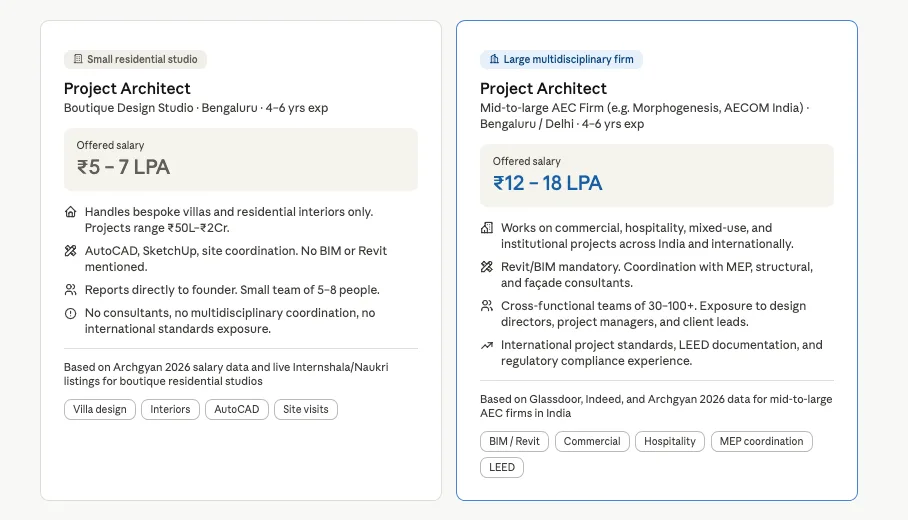
A small design studio may offer as little as ₹15,000/month to a fresh graduate, while a BIM-led practice or infrastructure consultancy might offer ₹28,000–35,000 for a fresh graduate with Revit skills. That gap only widens with experience.
International firms like AECOM, Arup, WSP, Jacobs, and Mott MacDonald operating in India typically pay 30–50% above local firm rates.
Mistake #3: Ignoring Construction Knowledge
One of the biggest differences between average earners and high earners is practical construction knowledge.
It is a known fact across the industry that firms pay more for architects who understand execution, not just design.
Many architects can produce beautiful drawings. Far fewer can answer questions such as:
- Why did a waterproofing system fail?
- How should a façade detail be modified during execution?
- What is causing a recurring site coordination issue?
- How can a drawing be adjusted to reduce construction delays?
- What happens when MEP services clash with structural elements on site?
Architects who regularly visit construction sites often develop faster professionally because they understand the real-world consequences of design decisions.
When project deadlines are tight and site issues arise, firms rely on architects who can solve practical problems. Those professionals naturally become more valuable to employers and clients.
Mistake #4: No Personal Brand or Professional Visibility
In today’s digital era, professional visibility can directly influence career growth.
Many architects do excellent work but remain completely invisible outside their immediate office environment. As a result, recruiters, firms, consultants, and potential clients never discover them.
On the other hand, architects who consistently showcase their work, insights, project learnings, BIM expertise, visualization skills, or site experiences often create opportunities that would not have existed otherwise.
After a few years of experience, your name should start working for you.
Some practical ways architects build visibility include:
- Publishing project breakdowns on LinkedIn
- Sharing BIM workflows and technical insights
- Showcasing construction site learnings
- Presenting portfolio case studies
- Speaking at architecture events and webinars
- Participating in design competitions
Many recruiters now search LinkedIn before reaching out to candidates. A strong professional presence can significantly increase the number and quality of opportunities that come your way.
Mistake #5: Not Learning Skills the Market Pays Premiums For
Not every architecture skill is rewarded equally in the job market.
The market pays premiums for skills that are difficult to find and directly impact project outcomes.
Unfortunately, many architects continue investing years into skills that have become standard expectations rather than differentiators.
Today, some of the most sought-after skills include:
- BIM authoring and coordination
- Revit expertise
- Navisworks clash detection
- Construction documentation
- Project management
- Consultant coordination
- Digital construction workflows
- Parametric design tools
- Sustainability and green building expertise
- Advanced visualization workflows
Employers rarely pay significantly more because someone knows basic AutoCAD or SketchUp. They pay more when an architect can reduce project risks, improve coordination, manage teams, accelerate delivery, or solve complex technical challenges.
The earlier you identify and develop high-value skills, the faster your career and salary growth typically accelerate.
A Practical 8-Month Roadmap to Reach ₹1 Lakh+ Faster
Let us look at a practical roadmap that we have seen work repeatedly for architects who are serious about accelerating their careers. This is very similar to the framework we share with many of our students.
Months 1-2: Identify Your Skill Gaps and Pick a High-Value Career Path
Before learning anything new, spend time understanding where you currently stand.
Review at least 30 job descriptions for positions such as:
- BIM Architect
- BIM Coordinator
- Project Architect
- Senior Architect
- Design Architect
Create a simple spreadsheet and track the skills that appear most frequently.
You will quickly notice recurring requirements such as:
- Revit
- BIM workflows
- Construction documentation
- Consultant coordination
- Site experience
- Project management
At this stage, choose one clear direction instead of trying to learn everything at once.
Also Read: Career Opportunities After Learning Revit and BIM
Months 3-4: Build Revit and BIM Proficiency
This is where many architects create a major competitive advantage.
Instead of learning isolated software commands, focus on creating a complete project in Revit.
Practice:
- Architectural modeling
- Sheet creation
- Working drawings
- Schedules
- Families
- Documentation standards
By the end of Month 4, you should have at least one complete BIM project that can be showcased in your portfolio.
Most architects stop after learning software basics. Very few build project-ready BIM documentation skills.
Months 5-6: Develop Construction and Coordination Skills
During these two months, focus on understanding how architectural, structural, and MEP systems work together. Study real project drawings, learn common coordination issues, and understand how clashes are identified and resolved.
If possible, spend time on construction sites to see how designs are executed in practice. Firms consistently pay more for architects who can solve coordination and execution challenges, not just create drawings.
Month 7: Rebuild Your Portfolio and LinkedIn Profile
Most architecture portfolios focus only on final renders.
Instead, showcase your thinking process.
Include:
- BIM models
- Working drawings
- Documentation samples
- Coordination examples
- Site photographs
- Technical detailing
Update your LinkedIn profile with clear project responsibilities rather than generic descriptions.
For example, replace “Worked on residential projects” with “Prepared BIM-based construction documentation for a 1.2 lakh sq. ft. residential development.”
👉 Check out our masterclass on portfolio development rated 5 stars by 230+ students.
Month 8: Apply Strategically for Higher-Value Roles
Most architects apply for jobs randomly and hope for better opportunities. Instead, focus on firms hiring for BIM Architect, BIM Coordinator, and Project Architect roles, especially those working on large commercial, healthcare, and hospitality projects where BIM workflows are already established.
Use your updated portfolio and LinkedIn profile to reach out directly to hiring managers, project leads, and recruiters. The goal is not simply to switch jobs, but to move into a role where your new skills can create greater value and command a significantly higher salary.
By this stage, you should have stronger technical skills, better project understanding, and a more competitive portfolio. For many architects, this becomes the foundation for breaking out of the ₹25,000-₹50,000 salary bracket and moving towards ₹1 lakh per month and beyond.
How ASDAV Helps Architects Accelerate Salary Growth
Architecture colleges are often excellent at teaching design fundamentals, theory, and academic concepts. However, many graduates enter the job market without the practical skills that employers actively look for, such as BIM workflows, advanced Revit usage, project documentation, coordination, and visualization.
ASDAV was started with a clear goal: to help architects develop industry-relevant skills and become future industry leaders rather than just software users.
Our programs focus on practical, skill-based learning through comprehensive courses on Revit, Revit with BIM, SketchUp& Lumion, and other in-demand tools used by leading architecture and construction firms. Instead of simply teaching software commands, our courses are built around real-world workflows, project-based learning, and practical case studies that reflect actual industry requirements.
We also conduct short architecture masterclasses that help students and professionals get answers to specific career and technical questions. While YouTube can be a useful learning resource, it cannot provide personalized guidance, project reviews, or live problem-solving support. Through our live sessions, students can ask questions, interact with mentors, learn industry best practices, and gain insights from real project experiences.
Whether your goal is to become a BIM professional, improve your technical expertise, strengthen your portfolio, or prepare for higher-paying opportunities, ASDAV provides a structured learning path designed around the skills today’s employers value.If you are looking to accelerate your career growth and increase your earning potential, explore our online architecture courses and enroll in the upcoming batches.

Jasmine Ahluwalia is a Licensed Architect, Interior designer, Global Vastu consultant and the founder of ASDAV.
She is a graduate of Scuola Master F.lli Pesenti, Politecnico di Milano, and brings strong global exposure through academic learning and professional design projects. Her background combines architecture, interior design, and applied design education.
Before founding ASDAV, Jasmine worked as an assistant professor at Amity School of Architecture and Planning, Amity University Noida. Her research covers sustainable architecture, urban heat island reduction, and circular economy practices in construction. Her work has been published in Scopus indexed and peer reviewed journals as well. She also has strong international on-site experience from countries like Canada, Mauritius, UK, and many more.
Through ASDAV, she has trained more than 500 students across 25 cities. The ASDAV platform has 12+ instructors from IIT, SPA, CEPT and NID , and has delivered over 200 live learning sessions. Her mission is to bridge the gap between design education and real industry expectations, to deliver real growth for her students.
She designs spaces for a living, but her favourite project is designing careers.