Every day, we get at least 5 to 10 calls from civil, mechanical, and architecture graduates struggling to get shortlisted for BIM jobs in India.
One of the biggest challenges freshers face today is that most companies are asking for experience even for entry-level BIM roles. Along with that, many students are also confused about where to start, which software to learn, how to build a portfolio, and what companies actually expect during BIM interviews.
At ASDAV, we work closely with students who want to build a career in BIM and help them become industry-ready through our practical and placement-focused BIM certification course. Over the years, we have seen that companies are not only looking for degrees anymore. They want candidates who can practically work on Revit models, understand project workflows, coordinate drawings, and contribute from day one.
The good news is that it is absolutely possible to get a BIM job in India as a fresher, even without prior work experience, if you follow the right roadmap.
In this article, we are sharing the exact step-by-step approach that many successful BIM freshers follow to get shortlisted, build a strong portfolio, crack interviews, and start their BIM career with confidence in 2026.
What is BIM and Why Are Companies Hiring BIM Freshers?
BIM stands for Building Information Modeling. It is a modern digital process used in the architecture, engineering, and construction industry to plan, design, manage, and execute building projects more efficiently. Unlike traditional drafting methods where teams work separately, BIM allows architects, structural engineers, MEP teams, contractors, and consultants to collaborate on a single intelligent model.
One important thing students must understand is that BIM is not just a software. It is a complete workflow and project management process. Software like Revit, Navisworks, AutoCAD, and BIM 360 are tools used within the BIM ecosystem, but BIM itself is about coordination, data management, visualization, clash detection, and improving project execution.
Today, there is a growing demand for BIM professionals across construction, infrastructure, MEP, and architecture industries because companies want faster project delivery, fewer on-site errors, better coordination, and reduced construction costs.
Industries Hiring BIM Professionals in India
Today, BIM professionals are being hired across multiple sectors, including:
- Architecture firms
- Construction companies
- Infrastructure consultancies
- MEP design companies
- International outsourcing firms
- Real estate development companies
- Engineering and project management consultancies
Many of these companies work on international projects, which is why BIM standards and practical workflow understanding have become extremely important for freshers entering the industry.
Popular BIM Job Roles for Freshers
| Job Role | Main Responsibility |
| BIM Modeler | Creating and managing 3D BIM models |
| Revit Technician | Preparing detailed Revit-based drawings and documentation |
| MEP BIM Modeler | Working on HVAC, plumbing, and electrical BIM models |
| Structural BIM Modeler | Developing structural models and detailing |
| BIM Coordinator Trainee | Supporting coordination between multiple disciplines |
| BIM Engineer | Assisting in BIM implementation and project workflows |
| Quantity Takeoff/BIM Estimation Executive | Extracting quantities and project data from BIM models |
One important industry insight is that many companies now conduct practical software tests during hiring instead of focusing only on academic marks. This is why students who build strong portfolios and understand project workflows often get shortlisted faster, even as freshers with no prior experience.
Want to Learn Revit & BIM?
Join ASDAV’s live session based Professional Revit & BIM Certification Course. Learn practical industry skills from experts. New batches are starting soon.
Can You Get a BIM Job Without Experience?
Yes, absolutely. But only if you can prove your skills practically.
One of the biggest misconceptions among freshers is that companies only hire candidates with prior experience. In reality, many BIM companies are open to hiring freshers if they can demonstrate software knowledge, project understanding, and the ability to work in a professional BIM workflow environment.
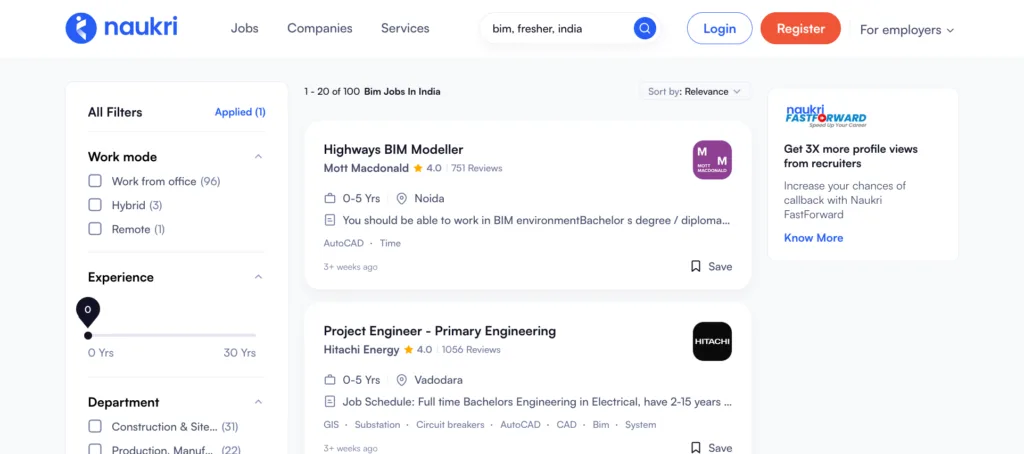
Here are some of the recent BIM opportunities published on naukri.com for freshers:
In fact, over the last 10+ years of working closely with students and the BIM industry, one pattern we have personally seen again and again is that companies usually reject freshers not because they lack experience, but because they lack practical skills.
Many students come with good academic scores or theoretical engineering knowledge, but struggle when recruiters ask them to:
- Create a proper Revit model
- Read construction drawings
- Explain BIM coordination
- Organize project files
- Identify clashes between disciplines
- Work according to industry standards
This is where most freshers lose opportunities.
BIM hiring has become much more skill-focused. Recruiters want candidates who can contribute to projects from the beginning, even at a trainee level. A fresher with a strong BIM portfolio and practical training often gets shortlisted faster than someone with only classroom knowledge.
Step-by-Step Roadmap to Get a BIM Job as a Fresher
Getting your first BIM job is not about randomly learning software or applying to hundreds of companies. It is about following the right roadmap step by step. Below, we are sharing the exact practical approach that helps freshers become industry-ready and improve their chances of getting shortlisted for BIM roles, even without prior experience.
Step 1: Learn the Right BIM Software
One of the first steps to getting a BIM job as a fresher is learning the right BIM software that companies actually use in real projects. Many colleges still focus heavily on theoretical engineering concepts and traditional drafting methods, which is why students often graduate without practical BIM exposure.
To become industry-ready, you should focus on learning software that is commonly used by architecture, construction, structural, and MEP firms.
Important BIM Software to Learn
- Revit Architecture
- Revit Structure
- Revit MEP
- AutoCAD
- Navisworks
- BIM 360
- Dynamo Basics
One important thing we always suggest to students is not to learn everything at once. Start with one specialization based on your background and build strong practical understanding step by step.
For example:
- Architecture students can start with Revit Architecture
- Civil students can focus on Structural BIM
- Mechanical and electrical students can move toward MEP BIM
Practical Learning Timeline
| Month | Focus Area |
| Month 1 | Revit basics |
| Month 2 | Family creation + modeling |
| Month 3 | Live project practice |
| Month 4 | Portfolio + interview prep |
This type of structured and practical learning approach helps freshers become job-ready much faster compared to only watching random tutorials online.
Also Read: Top 12 BIM Software Every Architect Should Know
Step 2: Build a BIM Portfolio Even Without a Job
When you apply for BIM jobs as a fresher, most companies understand that you may not have prior industry experience. But they still want proof that you can actually work on BIM projects. This is where a strong BIM portfolio becomes extremely important.
In fact, your portfolio is often the biggest deciding factor during fresher hiring. A good portfolio shows recruiters that you understand modeling, coordination, documentation, and practical BIM workflows instead of just completing a software course certificate.
What Projects Should You Include in Your BIM Portfolio?
Your BIM portfolio should include practical project samples such as:
- Residential building model
- MEP coordination model
- Clash detection sample
- BOQ extraction example
- Sheet creation samples
- Working drawings and documentation
- Revit family creation samples
- Project workflow screenshots
Even if these are practice projects or training-based projects, they can still make a strong impact if presented properly.
For example, instead of uploading only screenshots, explain:
- What the project was about
- Which software you used
- What challenges you solved
- How coordination was managed
- What outputs were generated
This makes your portfolio look much more professional and industry-ready.
At ASDAV, we have also seen that many students struggle not with learning software, but with presenting their work properly during interviews and applications. That is why we conduct a dedicated Portfolio Development Masterclass where students learn how to create an industry-ready BIM portfolio with practical guidance and live sessions.
Step 3: Get Practical Training Instead of Only Watching Tutorials
While YouTube and free online resources have made BIM learning more accessible, and there are definitely some great tutorials available online, many students eventually realize that random videos alone are usually not enough to become industry-ready.
One of the biggest problems with self-learning is that students often learn software features in isolation without understanding actual BIM workflows used in real projects. Along with that, many freshers struggle with doubts, project errors, coordination issues, practical case studies, and industry-specific questions that generic tutorials usually do not cover.
We have personally seen students spend months watching tutorials but still struggle during interviews because they never worked on structured live projects or practical BIM assignments.
That is why you need a complete end-to-end learning experience instead of fragmented learning.
A proper BIM training program should help you understand:
- How real BIM projects are executed
- How teams coordinate together
- How industry standards are followed
- How drawings and sheets are managed
- How portfolios are created professionally
- How technical interviews are conducted
At Asian School of Design & Applied Vastu, we offer a comprehensive Professional Revit & BIM Course for Architects designed specifically for students and freshers who want practical industry exposure. The program is conducted through 12 weeks of live session-based training with mentor guidance and practical implementation.
The training focuses on:
- Live project simulations
- Industry standards
- Clash detection workflow
- Sheet setup
- Coordination process
- Portfolio building
- Interview preparation
The goal is not just to teach software buttons, but to help students become confident enough to work on real BIM projects and improve their chances of getting placed in the industry.
Also Check Out: Most Recommended BIM Courses
How Freshers Can Get BIM Internships in India
One of the best ways to enter the BIM industry as a fresher is through internships and trainee opportunities. During our BIM certification course at Asian School of Design & Applied Vastu, we guide students on how to prepare for internships, improve their portfolios, and approach companies professionally. Once students complete the program successfully, we also offer 100% placement assistance to help them connect with relevant BIM opportunities.
Now, for students who are planning to apply for BIM internships on their own, here are some useful platforms and practical tips that can improve your chances of getting shortlisted.
Platforms to Apply for BIM Internships
- Naukri.com
- Indeed
- Internshala
- Company career pages
- BIM and architecture community groups – Facebook, Reddit, Whatsapp, and Telegram
Practical Tips to Get BIM Internship Opportunities
- Build a proper BIM portfolio before applying
- Apply consistently instead of waiting for one perfect opportunity
- Connect with BIM managers and recruiters on LinkedIn
- Share your BIM projects online regularly
- Practice software tests before interviews
- Learn basic interview communication skills
- Focus on one BIM specialization initially
- Attend BIM webinars and industry events
- Keep your resume simple and project-focused
- Be open to trainee and internship roles initially
Many students underestimate how important consistency and practical presentation are during internship applications. Even freshers with no prior experience can get shortlisted if they showcase strong project work, software understanding, and willingness to learn.
Frequently Asked Questions
Can a fresher get a BIM job in India?
Yes. Many BIM companies in India hire freshers if they have practical Revit skills, project-based portfolio work, and understanding of BIM workflows. Most recruiters focus more on software tests and portfolio quality than prior experience.
Check out these BIM job vacancies added on Naukri.com for freshers with decent salary packages and great learning opportunities.
Which BIM software is best for beginners?
For most beginners, especially architecture and civil students, Revit is the best software to start with because it is widely used across BIM projects in India and Gulf countries. MEP students can additionally focus on Revit MEP and Navisworks.
Is BIM a good career for civil engineers?
Yes. BIM is becoming one of the fastest-growing career paths for civil engineers due to increasing adoption in infrastructure, construction, and smart city projects. It also offers strong international opportunities in countries like the UAE and Saudi Arabia.
What is the salary of a BIM fresher in India?
A BIM fresher in India typically earns between ₹2.5 LPA to ₹5 LPA depending on software skills, portfolio quality, city, and specialization. Candidates with practical project experience usually receive better packages.
Can I learn BIM without experience?
Yes. BIM can be learned without prior industry experience if you follow structured practical training, work on projects, and build a proper portfolio. Many successful BIM professionals started as freshers with no site or office experience.
Does BIM require coding?
No, coding is not mandatory for most BIM jobs. However, learning basic Dynamo scripting or automation tools later can help you move into advanced BIM and improve career growth opportunities.
Most students can become job-ready in BIM within 3 to 6 months if they focus consistently on practical learning, live projects, portfolio development, and interview preparation instead of only theory-based learning.

Jasmine Ahluwalia is a Licensed Architect, Interior designer, Global Vastu consultant and the founder of ASDAV.
She is a graduate of Scuola Master F.lli Pesenti, Politecnico di Milano, and brings strong global exposure through academic learning and professional design projects. Her background combines architecture, interior design, and applied design education.
Before founding ASDAV, Jasmine worked as an assistant professor at Amity School of Architecture and Planning, Amity University Noida. Her research covers sustainable architecture, urban heat island reduction, and circular economy practices in construction. Her work has been published in Scopus indexed and peer reviewed journals as well. She also has strong international on-site experience from countries like Canada, Mauritius, UK, and many more.
Through ASDAV, she has trained more than 500 students across 25 cities. The ASDAV platform has 12+ instructors from IIT, SPA, CEPT and NID , and has delivered over 200 live learning sessions. Her mission is to bridge the gap between design education and real industry expectations, to deliver real growth for her students.
She designs spaces for a living, but her favourite project is designing careers.