Building Information Modeling (BIM) is becoming one of the fastest-growing fields in the architecture, engineering, and construction industry. According to a report by SNS Insider, the global BIM market was valued at $9.34 billion in 2025 and is expected to reach $29.63 billion by 2035, growing at a CAGR of 12.24%.
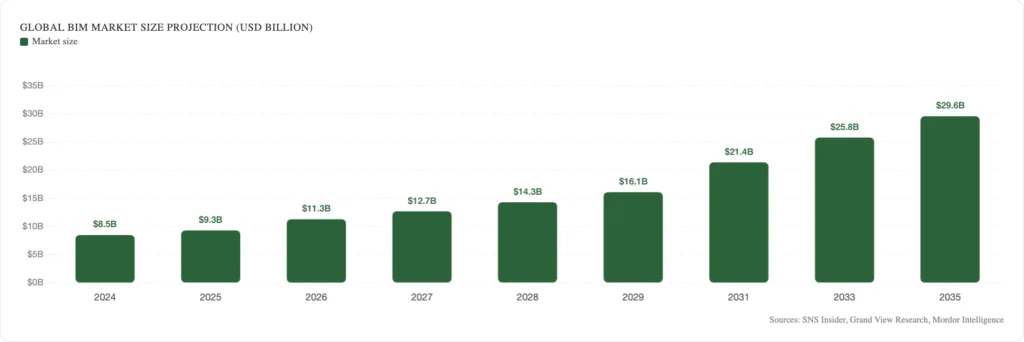
This growth is being driven by increasing adoption of digital construction technologies, smart infrastructure projects, and the need for better project planning and collaboration.
India is also witnessing a steady rise in BIM adoption. Real estate developers, construction companies, infrastructure firms, and engineering consultancies are increasingly looking for professionals who can work with BIM tools and workflows. As more projects move toward digital construction practices, the demand for skilled BIM professionals continues to grow.
If you are a student, recent graduate, or working professional wondering whether BIM is a good career choice in India, this guide will help you understand the salary potential, career scope, future opportunities, and the skills required to build a successful career in the BIM industry.
What Is BIM (Building Information Modeling)?
Building Information Modeling (BIM) is a digital process used to plan, design, construct, and manage buildings and infrastructure projects. Instead of creating simple 2D drawings, BIM allows professionals to develop intelligent 3D models that contain detailed information about every element of a project, including walls, doors, windows, structural components, electrical systems, plumbing networks, and more.
The main advantage of BIM is that it helps architects, engineers, contractors, and project managers work together using a shared model. This improves coordination, reduces design errors, minimizes project delays, and helps teams make better decisions throughout the project lifecycle.
Today, BIM is widely used across residential, commercial, industrial, and infrastructure projects around the world.
Common BIM Software Used in the Industry
Professionals working in BIM often use a combination of software depending on their role and project requirements. Some of the most widely used BIM tools include:
- Autodesk Revit for architectural, structural, and MEP modeling
- Navisworks for clash detection and project coordination
- AutoCAD for drafting and documentation
- Civil 3D for civil engineering and infrastructure design
- Bentley OpenBuildings for building design and analysis
- Tekla Structures for structural steel and concrete detailing
- Solibri for model checking and quality assurance
- Synchro 4D for construction planning and scheduling
- BIM 360 / Autodesk Construction Cloud for cloud-based collaboration and project management
Among these, Revit remains one of the most in-demand BIM software platforms in India and is often the first tool that aspiring BIM professionals are encouraged to learn.
Is BIM a Good Career in India in 2026?
Yes, BIM is one of the most promising career paths in the architecture, engineering, and construction industry today. As more companies adopt digital construction practices and governments invest heavily in infrastructure development, the demand for skilled BIM professionals is expected to continue growing in the coming years.
Let’s take a look at some key trends and industry developments that show why BIM is becoming a strong career choice in India.
Industry Demand for BIM Professionals
One of the biggest reasons BIM is becoming a strong career option in India is the rapid growth of the architecture, engineering, and construction (AEC) industry.
According to industry reports, the Indian construction market was valued at around $685 billion in 2025 and is expected to cross $1.24 trillion by 2034. Other market estimates project the sector to exceed $1.1 trillion by 2031, making India one of the fastest-growing construction markets in the world.
The construction sector already contributes nearly 9% of India’s GDP, accounts for more than 12% of total employment, and represents approximately 6.8% of the global construction market. Industry forecasts suggest continued growth through the rest of the decade, driven by urbanization, housing demand, transportation projects, industrial corridors, airports, metro networks, and smart city developments.
The Indian government is also investing heavily in infrastructure. In the 2026-27 budget, infrastructure spending was increased to a record ₹12.2 trillion, highlighting the country’s long-term focus on roads, railways, airports, logistics hubs, energy projects, and urban development.
As projects become larger and more complex, traditional CAD-based workflows are no longer enough. Developers, contractors, architects, and engineering consultants are increasingly adopting BIM to improve collaboration, reduce design clashes, control costs, and accelerate project delivery. Major infrastructure groups and developers are actively investing in BIM-based project delivery systems. For example, the Adani Group recently expanded its use of Autodesk Construction Cloud and BIM technologies across its infrastructure portfolio.
The trend is not limited to India. Globally, the BIM market is expected to grow, reflecting the increasing adoption of digital construction practices worldwide.
What does this mean for students and professionals?
Every year, thousands of new construction, real estate, infrastructure, and industrial projects require skilled professionals who can create, manage, coordinate, and review BIM models. As more Indian firms work with international clients in the Middle East, Europe, Australia, and North America, the demand for BIM Modelers, BIM Coordinators, BIM Engineers, and BIM Managers is expected to continue growing.
In simple terms, the growth of India’s construction industry is creating a parallel demand for BIM professionals. As long as the industry keeps expanding and digitizing, companies will continue looking for people with BIM skills.
Job Availability
A growing industry is only valuable if it creates jobs. Fortunately, BIM is doing exactly that.
If we look at the current job market, the demand for BIM professionals is clearly visible across major hiring platforms. LinkedIn alone shows more than 2,000 BIM-related job openings in India, including roles such as BIM Modeler, BIM Engineer, BIM Coordinator, and BIM Manager.
In addition, there are more than 1,000 BIM Engineer positions currently listed across the country.
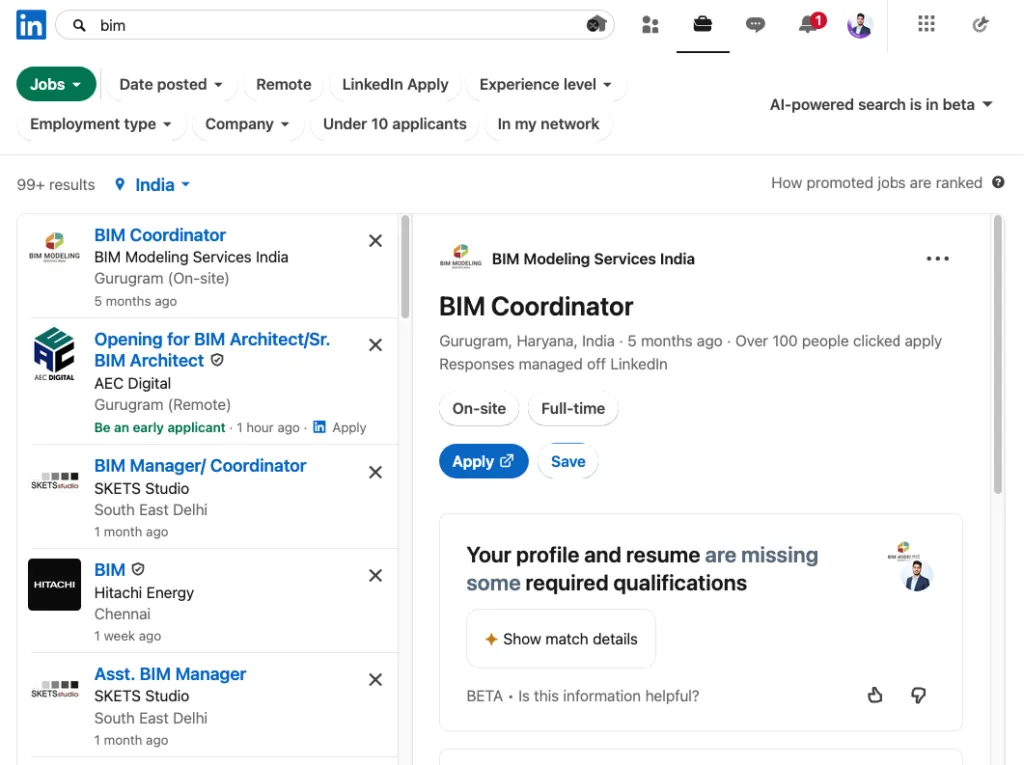
The demand becomes even more evident when looking at BIM-specific skills. LinkedIn currently lists hundreds of openings for BIM Modelers, MEP BIM professionals, Revit specialists, and structural BIM experts across cities such as Bengaluru, Mumbai, Chennai, Pune, Noida, Gurugram, and Hyderabad.
What’s particularly encouraging is that BIM opportunities are no longer limited to Indian projects. Many international engineering and construction firms have established BIM delivery centers in India, creating opportunities to work on projects in the Middle East, Europe, Australia, and North America while being based in India. Remote BIM and Revit positions are also becoming increasingly common.
In simple terms, the job market already shows strong demand for BIM professionals, and the number of opportunities is expected to grow further as more construction and infrastructure projects adopt BIM workflows.
Career Options in BIM
Another reason BIM is a good career choice is the variety of roles available within the field. As you gain experience, you can move into more specialized or managerial positions rather than staying in a single role throughout your career.
Some of the most common career options in BIM include:
- BIM Modeler – Creates 3D models for architectural, structural, or MEP projects.
- Revit Technician – Develops project models and construction documentation using Revit.
- BIM Engineer – Works on project coordination, modeling standards, and technical implementation.
- BIM Coordinator – Manages collaboration between different disciplines and resolves design clashes.
- BIM Manager – Oversees BIM processes, standards, teams, and project delivery.
- MEP BIM Specialist – Focuses on mechanical, electrical, and plumbing systems.
- Structural BIM Specialist – Specializes in structural modeling and detailing.
- BIM Consultant – Advises organizations on BIM adoption, workflows, and implementation strategies.
- Digital Construction Specialist – Uses BIM alongside technologies such as 4D planning, 5D cost estimation, and digital project management.
This career path also offers clear growth opportunities. Many professionals start as BIM Modelers or Revit Technicians and gradually progress to BIM Coordinator, BIM Manager, or BIM Consultant roles as they gain experience and project exposure.
BIM Salary Range in India
One of the biggest advantages of choosing BIM as a career is its strong salary growth potential. While freshers may start with moderate packages, professionals who develop expertise in tools such as Revit, Navisworks, Civil 3D, Dynamo, and Autodesk Construction Cloud often see significant salary growth within a few years.
The table below provides a realistic salary range based on current industry trends:
| Experience Level | Typical Roles | Expected Salary |
| 0-2 Years | BIM Modeler, Revit Technician | ₹3 – ₹5 LPA |
| 2-4 Years | BIM Engineer, BIM Designer | ₹5 – ₹8 LPA |
| 4-7 Years | BIM Coordinator, Senior BIM Engineer | ₹8 – ₹12 LPA |
| 7-10 Years | BIM Manager, Project BIM Lead | ₹12 – ₹20 LPA |
| 10+ Years | BIM Consultant, Digital Construction Manager | ₹20 – ₹30+ LPA |
Industry data shows that entry-level BIM professionals typically earn between ₹3-6 LPA, while experienced BIM Managers can earn ₹12-20 LPA or more. Senior specialists and consultants working on large infrastructure or international projects often command even higher compensation.
Sources: Salary ranges are based on BIM compensation data published by industry platforms including Glassdoor, AmbitionBox, Indeed, Talent.com, BIM salary reports, and BIM career surveys conducted across India and global AEC markets.
Skills That Can Increase Your Salary
Not all BIM professionals earn the same salary. Companies generally pay higher packages to candidates who possess specialized BIM skills such as:
- Autodesk Revit
- Navisworks Clash Detection
- BIM 360 / Autodesk Construction Cloud
- Dynamo Automation
- Civil 3D
- Tekla Structures
- 4D Construction Planning
- 5D Cost Estimation
- ISO 19650 Standards
- MEP BIM Coordination
Professionals who combine BIM expertise with domain knowledge in architecture, structural engineering, MEP engineering, or infrastructure projects are usually among the highest-paid candidates in the industry. In many cases, adding advanced coordination and automation skills can increase earning potential by several lakhs per year compared to Revit-only profiles.
Another important factor is international exposure. Many BIM professionals in India work on projects located in the UAE, Saudi Arabia, the UK, Australia, and North America through global delivery centers. These opportunities often offer higher compensation and faster career progression compared to traditional drafting or design roles.
Scope of BIM Certification Courses in India and Globally
While architecture, civil engineering, and related degree programs provide a strong academic foundation, most colleges in India and many institutions around the world still focus heavily on theoretical concepts. As a result, there is often a gap between what students learn in college and the practical BIM skills that employers expect from new hires.
This is where a BIM certification course can make a significant difference.
A typical BIM certification program lasts around 3 to 4 months and focuses on practical, industry-oriented training. Students learn how to work with BIM software, create project models, collaborate across disciplines, detect design clashes, and follow industry workflows used by leading architecture, engineering, and construction firms.
The biggest advantage of a BIM certification course is that it helps students become job-ready much faster. Instead of spending months learning software after graduation, students gain hands-on experience during the course itself.
BIM certifications are valued by employers in India as well as international markets such as the UAE, Saudi Arabia, the UK, Australia, and North America. Companies are often more interested in a candidate’s practical BIM skills and project experience than theoretical knowledge alone.
When choosing a BIM course, live training programs generally offer additional benefits. Live classes provide direct interaction with trainers, doubt-solving sessions, project reviews, and personalized feedback that can be difficult to achieve through self-paced learning.
Learn BIM with Asian School of Design & Applied Vastu
At Asian School of Design & Applied Vastu, we help students and professionals build successful careers in BIM through a comprehensive Revit & BIM Certification Program.
Our 12-week live Revit & BIM training program is designed to bridge the gap between academic education and industry requirements. The course includes:
- Live instructor-led classes
- Complete Revit & BIM training
- Real-world project work
- Industry-standard workflows
- Small batch sizes for personalized attention
- Practical assignments and guidance
- Industry-recognized certification upon completion
- Rated 5 star by 500+ students on Google and Trustpilot
Whether you are a student, architect, civil engineer, interior designer, or working professional, the program is designed to help you develop the skills that modern construction and design companies actively look for when hiring BIM professionals.
Explore Further:
- How to Get a BIM Job in India as a Fresher in 2026 (Complete Steps)
- 5 Most Recommended BIM Courses for 2026 Batch
- How Much Does BIM Course Cost in India?
Frequently Asked Questions
1. Can AI Replace BIM Professionals?
No. AI can automate certain repetitive tasks such as model checking, clash detection, documentation, and data analysis, but it cannot replace BIM professionals completely. BIM projects require design coordination, engineering judgment, problem-solving, client communication, and project-specific decision-making. In fact, AI is expected to become a tool that helps BIM professionals work faster rather than replacing them.
2. How Can I Get a BIM Job as a Fresher?
The most effective way is to build practical BIM skills, create project-based portfolios, and gain proficiency in software such as Revit and Navisworks. Employers typically look for candidates who can contribute to projects from day one. Our team has prepared a detailed guide on How to Get a BIM Job as a Fresher, covering skills, certifications, portfolio tips, interview preparation, and job search strategies.
3. How Much Does a BIM Certification Course Cost in India?
The cost of a BIM certification course in India generally ranges between ₹20,000 and ₹1,00,000 depending on the course duration, curriculum, trainer experience, and project exposure provided.
At Asian School of Design & Applied Vastu, we offer a comprehensive 3-month Revit & BIM Certification Course for ₹50,000. We also provide special discounts for eligible and interested students. The program includes live classes, practical assignments, real-world projects, and an industry-recognized certification.
4. Which BIM Software Should Beginners Learn First?
For most students and freshers, Autodesk Revit is the best place to start. Revit is currently the most widely used BIM software across architecture, structural engineering, and MEP projects. Once you become comfortable with Revit, you can expand your skills by learning Navisworks, BIM 360, Civil 3D, Dynamo, and other advanced BIM tools.
5. Is BIM a Good Career for Civil Engineers and Architects?
Yes. BIM is one of the most promising career options for both civil engineers and architects. The demand for BIM professionals continues to grow as construction companies, design firms, infrastructure consultants, and project management organizations adopt digital construction workflows.
With the right training and experience, BIM professionals can access opportunities in India as well as international markets such as the UAE, Saudi Arabia, the UK, Australia, and North America.
6. What Future Opportunities Will Be There in BIM in India and Other Countries?
Based on our experts and the team who actively works with BIM professionals and construction companies, the future of BIM looks extremely promising. Over the next decade, demand is expected to grow not only for BIM Modelers and Coordinators but also for specialists in areas such as Digital Construction, BIM Automation, 4D Planning, 5D Cost Management, Digital Twins, and Smart Infrastructure.
In India, major investments in metro rail projects, airports, highways, industrial corridors, smart cities, and large-scale real estate developments are expected to create thousands of BIM-related opportunities. Globally, countries such as the UAE, Saudi Arabia, the UK, Australia, Canada, and the United States are increasingly making BIM a standard requirement for large construction and infrastructure projects.
Professionals who combine BIM skills with Revit, Navisworks, Dynamo, Autodesk Construction Cloud, and project coordination expertise are likely to have the strongest career prospects in the coming years.

Jasmine Ahluwalia is a Licensed Architect, Interior designer, Global Vastu consultant and the founder of ASDAV.
She is a graduate of Scuola Master F.lli Pesenti, Politecnico di Milano, and brings strong global exposure through academic learning and professional design projects. Her background combines architecture, interior design, and applied design education.
Before founding ASDAV, Jasmine worked as an assistant professor at Amity School of Architecture and Planning, Amity University Noida. Her research covers sustainable architecture, urban heat island reduction, and circular economy practices in construction. Her work has been published in Scopus indexed and peer reviewed journals as well. She also has strong international on-site experience from countries like Canada, Mauritius, UK, and many more.
Through ASDAV, she has trained more than 500 students across 25 cities. The ASDAV platform has 12+ instructors from IIT, SPA, CEPT and NID , and has delivered over 200 live learning sessions. Her mission is to bridge the gap between design education and real industry expectations, to deliver real growth for her students.
She designs spaces for a living, but her favourite project is designing careers.