
Many students who reach out to us for NATA guidance have one thing in common. They start their preparation late. Some are busy with Class 12 board exams, while others spend months deciding whether architecture is the right career path. By the time they begin preparing seriously, they often have just four or five weeks left before the exam. Their first question is usually the same: Is one month enough to crack NATA?
The good news is that NATA is not a memory-based exam. You do not have to memorize large amounts of general knowledge or spend months learning theory. The exam is designed to assess skills such as drawing, observation, visualization, logical reasoning, spatial ability, and creative thinking. These are areas where focused practice can lead to noticeable improvement in a short period of time.
So, if you have only one month left, do not panic. With a structured 4-week study plan, regular mock tests, daily drawing practice, and expert feedback on your work, you can still prepare effectively and improve your performance significantly before exam day.
Can You Really Crack NATA in Just One Month?
The honest answer is yes, you can crack NATA in just one month. In fact, during our NATA training programs, we have seen many students make remarkable progress in less than 25 days and go on to perform well in the exam.
However, there is an important condition. You should already have some basic understanding of drawing, visualization, logical reasoning, and architectural aptitude. If you are starting completely from scratch and trying to learn every concept in the final month, the chances of achieving a strong score become much lower.
The last month should not be used to build foundations. It should be used to strengthen them. This is the stage where students should focus on improving drawing speed, solving aptitude questions, taking mock tests, identifying weaknesses, and getting regular feedback on their performance.
A one-month preparation strategy works best for Class 12 students, NATA repeaters, JEE B.Arch aspirants, and students who have some exposure to drawing or design-related activities. For these students, a focused 4-week plan can be enough to improve scores significantly and enter the exam with confidence.
Understand What NATA Actually Tests Before You Start Studying
Before creating a study plan, it is important to understand what NATA actually tests. Many students assume that NATA is similar to board exams or other entrance tests. In reality, it is designed to evaluate your creativity, observation skills, visualization ability, logical thinking, and architectural aptitude.
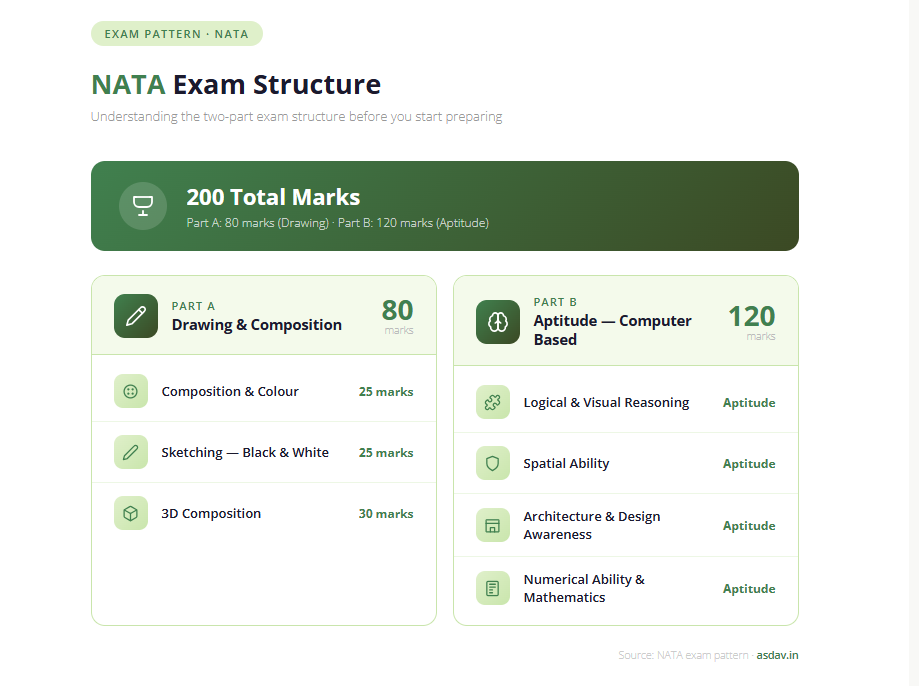
The exam is divided into two parts.
Part A: Drawing and Composition Test (80 Marks)
Part A is the drawing section and carries 80 marks in total. Students are given three drawing-based questions that test their creativity, visual communication skills, and ability to present ideas effectively. This section includes:
- Composition and Colour (25 Marks)
- Sketching and Composition in Black & White (25 Marks)
- 3D Composition (30 Marks)
Questions may require you to create scenes, arrange elements into a balanced composition, draw perspectives, visualize spaces, use colours effectively, or develop a three-dimensional concept. The focus is not on creating artwork but on demonstrating observation, proportion, creativity, and design thinking.
Part B: Aptitude Section (120 Marks)
Part B is the computer-based aptitude section worth 120 marks. This section evaluates how you think and solve problems rather than what you have memorized.
Key topics include:
- Logical Reasoning
- Visual Reasoning
- Spatial Ability
- Design Sensitivity
- Architecture and Design Awareness
- Language Interpretation
- Numerical Ability and Basic Mathematics
Students are tested on pattern recognition, analytical thinking, visual perception, problem solving, and their understanding of architecture and design concepts. Questions are designed to assess aptitude for architecture rather than subject-specific knowledge.
The biggest takeaway is that NATA is not a theory-heavy exam. Success depends more on regular drawing practice, strong visualization skills, logical thinking, and mock test performance than on memorizing large amounts of information. This is why a focused 4-week preparation strategy can still produce strong results.
Also Read: Is NATA Mandatory for Private Architecture Colleges?
The Ideal 4-Week NATA Preparation Plan
Now comes the most important part. If you have only one month left for NATA, every week needs a clear objective. The final month is not the time to keep switching between books, YouTube videos, and study plans. It is the time to identify weaknesses, improve your drawing skills, build speed, and practice under exam conditions.
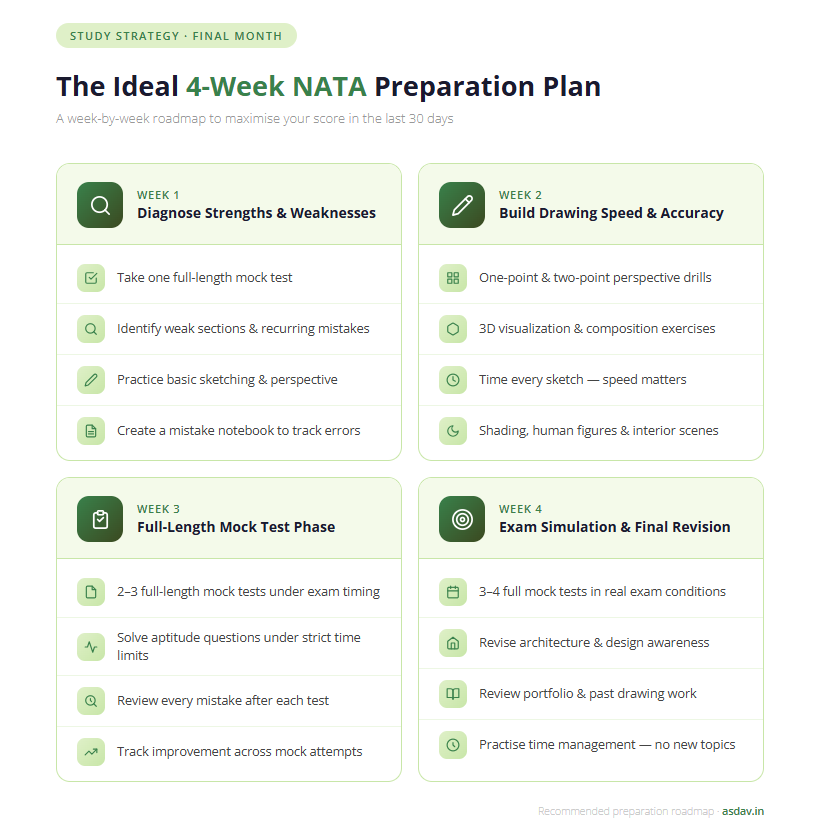
Here is a practical 4-week NATA preparation plan that we recommend to students.
Week 1: Diagnose Your Strengths and Weaknesses
The goal of the first week is not to learn new topics. It is to understand exactly where you stand.
Start by taking one full-length mock test under actual exam conditions. Most students are surprised by the results because they often overestimate their strengths and underestimate their weak areas.
Focus on these tasks:
- Take one complete mock test
- Identify weak sections and recurring mistakes
- Practice basic sketching and perspective fundamentals
- Revise logical reasoning concepts
- Create a mistake notebook to track errors
Daily Target:
- 2 hours drawing practice
- 1 hour aptitude preparation
- 30 minutes architecture and design awareness
This is also the reason why we have structured our online NATA Crash Course to begin with assessment and feedback rather than lengthy theory sessions. Before improving scores, students first need to understand exactly what is holding them back.
Week 2: Build Drawing Speed and Accuracy
Once you know your weak areas, the second week should focus heavily on drawing practice.
A common misconception is that students lose marks because they cannot draw. In reality, many students lose marks because they cannot complete quality drawings within the available time.
Focus on:
- One-point perspective
- Two-point perspective
- Human figures
- Interior and exterior scenes
- Shading techniques
- Composition exercises
- 3D visualization
An experienced NATA aspirant on Reddit recently shared that many drawing questions follow similar patterns. According to the student, recent papers frequently include logo design, signage creation, 2D compositions using specific shapes and colours, black-and-white 3D compositions, and design principle based modelling exercises.
The student’s advice was simple: practice perspectives, understand light and shadow, and learn core design principles such as movement, emphasis, balance, and dynamism.
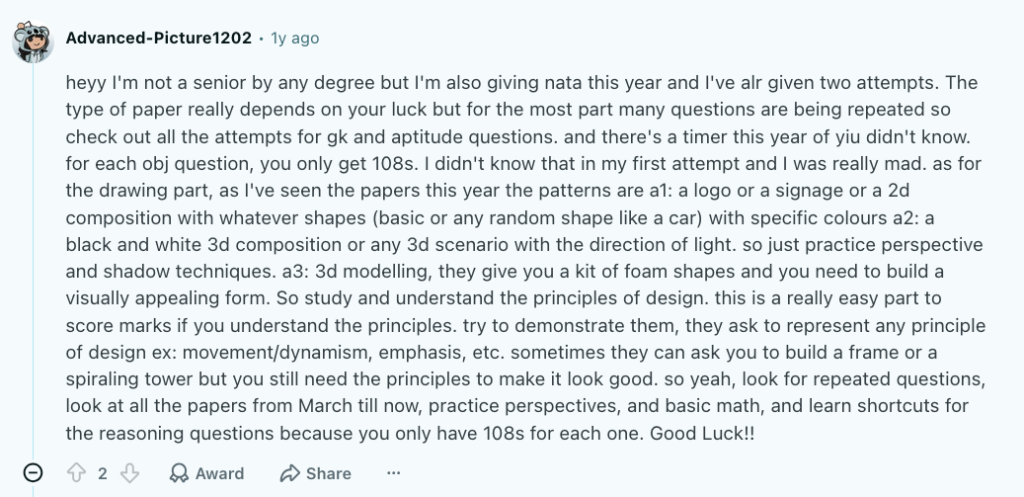
This is also the week where students should start timing every drawing exercise. A good sketch completed in 20 minutes is often more valuable than a perfect sketch that takes an hour.
Week 3: Full-Length Mock Test Phase
By Week 3, preparation should shift from learning to performance.
Many students spend weeks studying but never test themselves under actual exam pressure. This becomes a major problem on exam day.
Focus on:
- Taking 2 to 3 full-length mock tests
- Solving aptitude questions under strict timing
- Reviewing every mistake carefully
- Improving weak topics identified in mock tests
- Building speed without compromising accuracy
After every mock test, spend at least as much time reviewing mistakes as you spent taking the test. The biggest score improvements usually come from fixing recurring errors rather than learning entirely new topics.
This is where personalized feedback becomes extremely valuable because students often repeat the same drawing and aptitude mistakes without realizing it.
Week 4: Exam Simulation and Final Revision
The final week should be dedicated almost entirely to exam simulation.
At this stage, avoid starting new books, new courses, or new preparation strategies. Your focus should be confidence, consistency, and execution.
Focus on:
- 3 to 4 full-length mock tests
- Revision of architecture and design awareness
- Review of drawing portfolio and past work
- Revision of reasoning shortcuts and techniques
- Time management practice
Create the same environment as the actual exam whenever you take a mock test. Follow the same timing, avoid distractions, and complete every section within the prescribed duration.
The students who perform best in the final month are usually not the ones studying the longest hours. They are the ones who consistently practice, review mistakes, improve weak areas, and simulate the real exam multiple times before test day.
Also Read: NATA Vs JEE Main Paper 2: Which Is Better For Architecture
Daily NATA Study Schedule for the Final Month
The final month is all about consistency. You do not need to study for 10 to 12 hours a day. A focused daily routine that balances drawing practice, aptitude preparation, and revision is often far more effective.
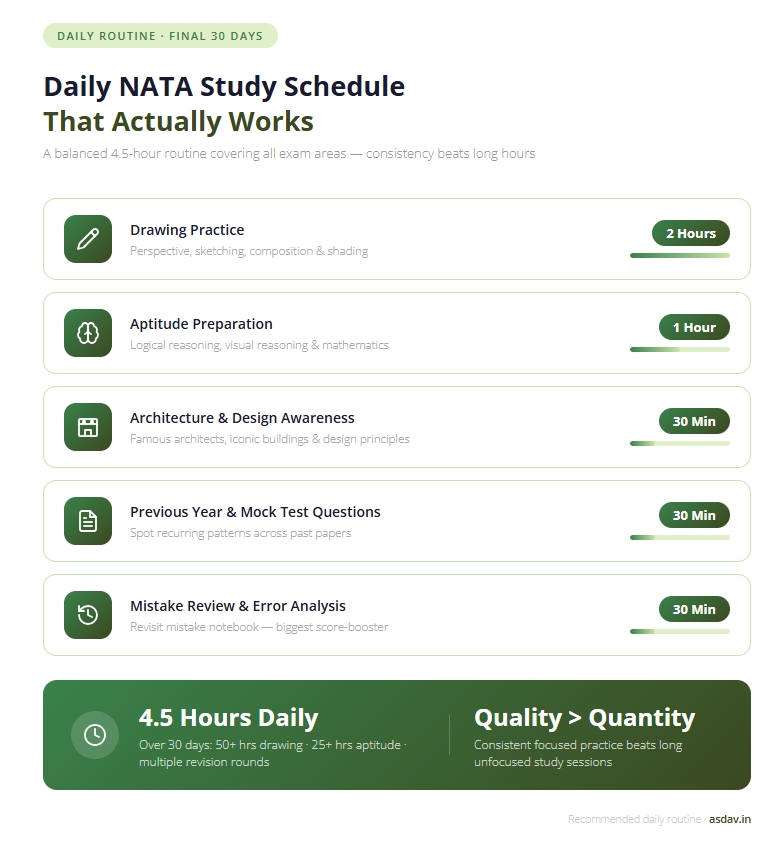
Here is a practical daily study schedule that many successful NATA aspirants follow during the last 30 days.
| Activity | Daily Time |
|---|---|
| Drawing Practice (Perspective, Sketching, Composition, Shading) | 2 Hours |
| Aptitude Preparation (Logical Reasoning, Visual Reasoning, Mathematics) | 1 Hour |
| Architecture & Design Awareness | 30 Minutes |
| Previous Year Questions & Mock Test Questions | 30 Minutes |
| Mistake Review & Error Analysis | 30 Minutes |
| Total Daily Study Time | 4.5 Hours |
How to Use This Schedule
- Use drawing practice to improve speed, perspective, shading, and composition skills.
- Solve aptitude questions under timed conditions whenever possible.
- Spend architecture awareness time learning about famous architects, iconic buildings, design principles, and current architecture trends.
- Review previous year and mock test questions to identify recurring patterns.
- Maintain a mistake notebook and revise it daily. Many students repeatedly lose marks on the same types of questions because they never review their errors.
If you can consistently follow this routine for four weeks, you will complete more than 50 hours of drawing practice, 25+ hours of aptitude preparation, and multiple rounds of revision before the exam. For most students, that is enough to create a noticeable improvement in both confidence and performance.
How ASDAV’s 4-Week NATA Crash Course Helps Students Prepare Faster
At the Asian School of Design & Applied Vastu (ASDAV), we understand that many students begin their NATA preparation late and need a focused, structured approach to maximize their score in a limited time. That is why we have designed a comprehensive 4-week NATA Crash Course that helps students focus on the areas that matter most in the final month before the exam.
The program includes 30 hours of live training over 4 weeks, covering drawing, aptitude, visualization, design principles, exam strategies, and time management. Students also take 3 full-length mock tests that simulate actual exam conditions and help identify areas that need improvement before test day.
The course goes beyond classroom teaching and includes:
- Personalized assessment and feedback
- 3 Full-Length Mock Tests
- Cohort discussions and peer learning
- Recorded sessions for revision
- One-on-one guidance from experienced faculty
- 30-day post-course support for continued preparation
This structured approach helps students avoid common mistakes, improve drawing speed, strengthen aptitude skills, and build confidence through consistent practice and expert feedback.
If you are planning to appear for the upcoming NATA exam and want a clear, practical preparation roadmap for the final month, this crash course can help you make the most of your remaining time. The course is rated 4.9/5 by students, and more than 100 students have already enrolled to strengthen their NATA preparation.
Seats are limited for each batch to ensure personalized attention and feedback. If your exam is approaching, now is the right time to begin focused preparation.

Jasmine Ahluwalia is a Licensed Architect, Interior designer, Global Vastu consultant and the founder of ASDAV.
She is a graduate of Scuola Master F.lli Pesenti, Politecnico di Milano, and brings strong global exposure through academic learning and professional design projects. Her background combines architecture, interior design, and applied design education.
Before founding ASDAV, Jasmine worked as an assistant professor at Amity School of Architecture and Planning, Amity University Noida. Her research covers sustainable architecture, urban heat island reduction, and circular economy practices in construction. Her work has been published in Scopus indexed and peer reviewed journals as well. She also has strong international on-site experience from countries like Canada, Mauritius, UK, and many more.
Through ASDAV, she has trained more than 500 students across 25 cities. The ASDAV platform has 12+ instructors from IIT, SPA, CEPT and NID , and has delivered over 200 live learning sessions. Her mission is to bridge the gap between design education and real industry expectations, to deliver real growth for her students.
She designs spaces for a living, but her favourite project is designing careers.