Most people think interior design is about decorating living rooms and choosing curtains. That limited view keeps them from seeing the full picture. Interior design in India has grown into a multi-sector industry that spans luxury residential projects, high-end hospitality, commercial office fit-outs, retail brand experiences, healthcare facilities, and sustainable building consultancy. The professionals working across these sectors are not just creative individuals. They are technical specialists commanding salaries that compete with software engineers and financial analysts.
India’s interior design market was valued at approximately $28 billion in 2023 and is projected to grow at 8-10% annually through 2030, according to industry reports from IBEF and Mordor Intelligence. This growth is driven by rapid urbanisation, rising disposable incomes, the expansion of organised retail, the hospitality sector boom, and the post-pandemic redesign of commercial workspaces. With this expansion comes demand for specialised interior design talent across multiple verticals.
Is Interior Design a High-Paying Career in India?
Interior design is a high-paying career in India for professionals who specialise in high-demand sectors, master industry-standard software, and build a portfolio that demonstrates real project experience. Entry-level salaries start modestly, but mid-career and senior professionals in the right specialisations earn significantly more than the national average for creative professions.
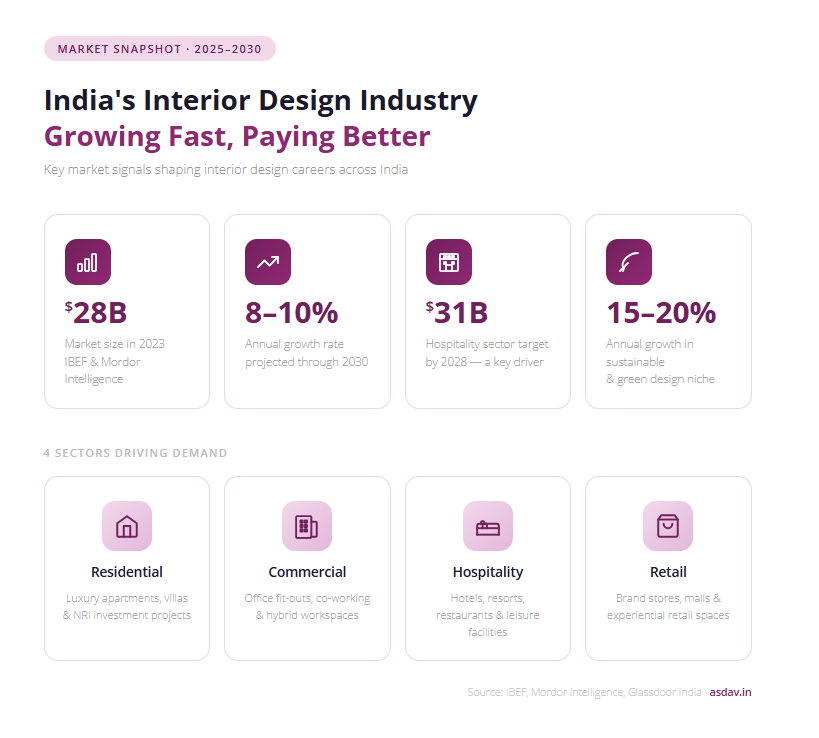
The demand for interior designers in India is driven by four major sectors:
- Residential: Luxury apartments, villas, and premium housing projects in metro and Tier-2 cities. The rise of NRI investments and high-net-worth individuals has created demand for designers who can deliver international-quality residential interiors.
- Commercial: Office fit-outs, co-working spaces, corporate headquarters, and tech parks. Post-pandemic workplace redesign has accelerated demand for designers who understand hybrid work environments, biophilic design, and employee wellness.
- Hospitality: Hotels, resorts, restaurants, cafes, and F&B outlets. India’s hospitality industry is projected to reach $31 billion by 2028, and every new property requires interior design expertise.
- Retail: Brand stores, showrooms, malls, and experiential retail spaces. With global brands expanding across Indian cities, retail interior design has become a high-paying specialisation.
Quick fact: According to Glassdoor India data from 2025, the average interior designer salary in India ranges from ₹3.5 LPA for freshers to ₹18-25 LPA for senior designers with 10+ years of experience. Specialists in hospitality and commercial design often earn 30-50% more than generalists.
Interior Designer Salary in India: Experience-Wise Breakdown
Salaries vary significantly based on experience, specialisation, location, and the type of firm (boutique studio vs. large corporate). Here is a realistic salary range for interior designers in India in 2026:
| Experience Level | Salary Range (₹ LPA) | Typical Roles |
|---|---|---|
| Fresher (0-1 years) | ₹2.5 – 5 LPA | Junior Designer, Design Assistant, CAD Drafter |
| Early Career (1-3 years) | ₹5 – 8 LPA | Interior Designer, 3D Visualiser, Site Coordinator |
| Mid-Level (3-6 years) | ₹8 – 15 LPA | Senior Designer, Project Designer, Design Lead |
| Senior (6-10 years) | ₹15 – 25 LPA | Principal Designer, Design Manager, Studio Head |
| Leadership (10+ years) | ₹25 – 50+ LPA | Creative Director, Partner, Founder, VP Design |
Which Interior Design Specialisations Pay the Most?
Not all interior design roles pay equally. Specialisation matters. Here are the highest-paying niches based on industry hiring data:
- Hospitality Interior Design: Hotels, resorts, and luxury F&B projects pay premium rates because of the complexity, scale, and brand standards involved. Senior hospitality designers earn ₹20-35 LPA.
- Commercial & Workplace Design: Corporate clients have large budgets and recurring project pipelines. Designers who understand workplace strategy and can manage multi-floor fit-outs command ₹15-25 LPA at mid-senior levels.
- Retail & Brand Experience Design: Global retail brands pay well for designers who can translate brand identity into spatial experience. Expect ₹12-22 LPA for experienced retail designers.
- Sustainable & Green Interior Design: With LEED and GRIHA certifications becoming standard for new commercial projects, sustainability specialists are in high demand. This niche is growing at 15-20% annually.
- BIM & Design Technology: Interior designers with Revit, BIM coordination, and computational design skills earn 20-40% more than those without. Tech-enabled design is the fastest-growing skill requirement.
Skills That Make Interior Designers More Employable
Employers hiring interior designers in India look for a combination of creative ability, technical proficiency, and project execution skills.
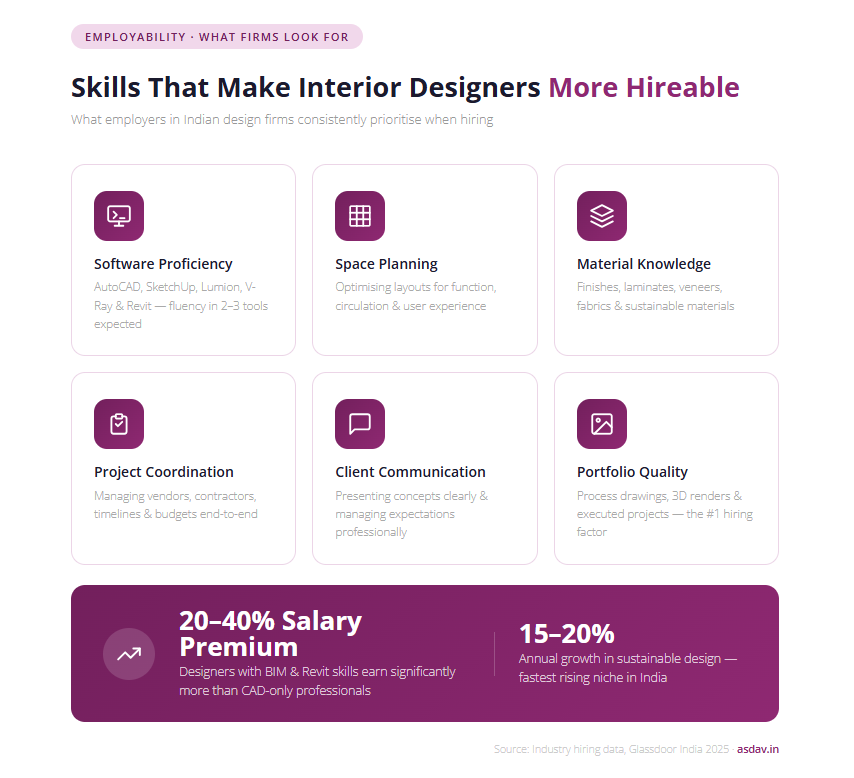
Here is what makes candidates stand out:
- Software proficiency: AutoCAD for 2D drafting, SketchUp for 3D modelling, Lumion or V-Ray for rendering, Revit for BIM-based projects. Firms expect fluency in at least 2-3 of these tools.
- Material knowledge: Understanding finishes, laminates, veneers, fabrics, tiles, and sustainable materials. Knowing what works within Indian budgets and supply chains is essential.
- Space planning: The ability to optimise layouts for function, circulation, and user experience. This is the core skill that separates decorators from designers.
- Project coordination: Managing vendors, contractors, timelines, and budgets. Designers who can execute projects without constant supervision get promoted faster.
- Client communication: Presenting concepts clearly, managing expectations, and handling revisions professionally. Soft skills matter more than most design schools teach.
- Portfolio quality: A well-documented portfolio showing process, drawings, 3D renders, and executed projects. This is the single most important factor in getting hired.
Top 10 High-Paying Interior Design Jobs in India
Interior design is not a single job. It is a field with multiple career paths, each with its own specialisation, skill requirements, and earning potential. Here are the top 10 high-paying interior design jobs in India, with details on what each role involves and how much you can expect to earn.
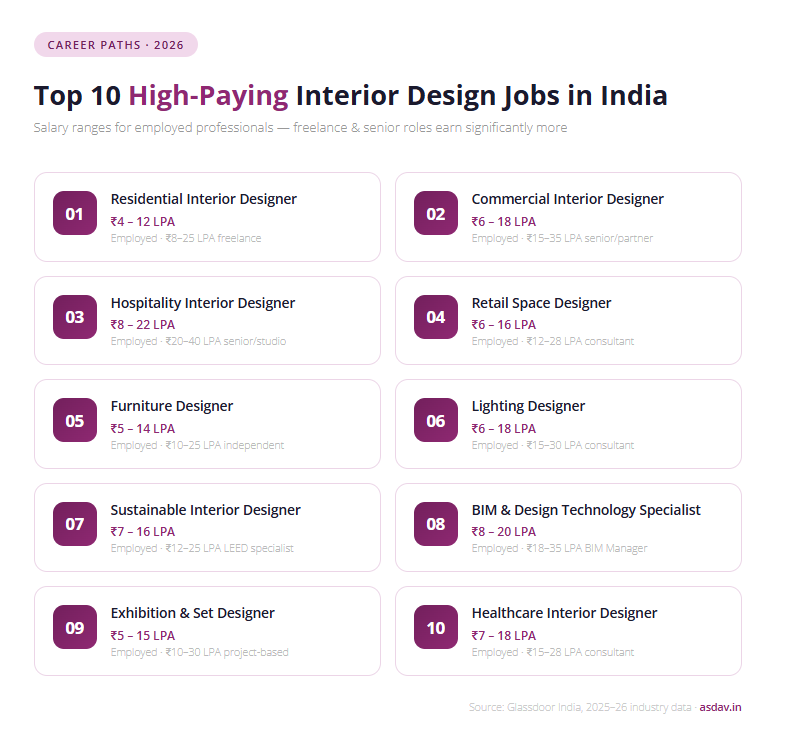
1. Residential Interior Designer
A residential interior designer plans and designs living spaces including apartments, villas, independent houses, and farmhouses. The work involves understanding client lifestyles, creating functional layouts, selecting materials and finishes, and coordinating with contractors for execution.
- Salary range: ₹4-12 LPA (employed) | ₹8-25 LPA+ (freelance/studio owner)
- Tools used: AutoCAD, SketchUp, Lumion, V-Ray, 3ds Max
- Growth path: Junior Designer → Senior Designer → Project Lead → Studio Owner
2. Commercial Interior Designer
A commercial interior designer specialises in office spaces, corporate headquarters, co-working environments, and business facilities. The work requires understanding workspace efficiency, compliance with fire and safety codes, and designing for employee productivity and brand identity.
- Salary range: ₹6-18 LPA (employed) | ₹15-35 LPA (senior/partner level)
- Tools used: AutoCAD, Revit, SketchUp, Space planning software
- Growth path: Designer → Project Manager → Workplace Strategist → Design Director
3. Hospitality Interior Designer
A hospitality interior designer works on hotels, resorts, restaurants, cafes, bars, and leisure facilities. This specialisation demands understanding of guest experience, brand storytelling through design, operational flow, and compliance with hospitality industry standards.
- Salary range: ₹8-22 LPA (employed) | ₹20-40 LPA (senior/studio level)
- Tools used: AutoCAD, Revit, 3ds Max, V-Ray, FF&E specification software
- Growth path: Junior Designer → Senior Designer → FF&E Specialist → Design Principal
4. Retail Space Designer
A retail space designer creates shopping environments for brand stores, showrooms, malls, and pop-up retail installations. The work focuses on visual merchandising, customer flow, brand experience, and maximising sales per square foot through strategic spatial design.
- Salary range: ₹6-16 LPA (employed) | ₹12-28 LPA (senior/consultant)
- Tools used: AutoCAD, SketchUp, Photoshop, Retail planning software
- Growth path: Designer → Visual Merchandiser → Retail Design Lead → Brand Experience Director
5. Furniture Designer
A furniture designer creates custom furniture pieces, modular systems, and product lines for residential, commercial, and contract markets. The role combines industrial design principles with interior sensibility, material science, and manufacturing knowledge.
- Salary range: ₹5-14 LPA (employed) | ₹10-25 LPA (independent/studio)
- Tools used: AutoCAD, SolidWorks, Rhino, SketchUp, CNC programming basics
- Growth path: Junior Designer → Product Designer → Design Head → Studio Founder
6. Lighting Designer
A lighting designer specialises in planning and specifying artificial and natural lighting for interior and architectural spaces. This niche role is critical for hospitality, retail, museums, and high-end residential projects where lighting defines atmosphere and user experience.
- Salary range: ₹6-18 LPA (employed) | ₹15-30 LPA (consultant/specialist)
- Tools used: DIALux, Relux, AGi32, AutoCAD, lighting calculation software
- Growth path: Lighting Associate → Lighting Designer → Senior Consultant → Lighting Practice Head
7. Sustainable Interior Designer
A sustainable interior designer focuses on environmentally responsible design using low-impact materials, energy-efficient systems, and circular economy principles. With LEED and GRIHA certification becoming standard for commercial projects, this specialisation is growing rapidly.
- Salary range: ₹7-16 LPA (employed) | ₹12-25 LPA (consultant/LEED specialist)
- Tools used: LEED documentation tools, LCA software, standard design software
- Growth path: Designer → Sustainability Coordinator → Green Building Consultant → Sustainability Director
8. BIM & Interior Design Technology Specialist
A BIM specialist for interior design works with Building Information Modelling software to create coordinated, data-rich 3D models that integrate with architecture, MEP, and construction teams. This role is essential for large-scale commercial and hospitality projects.
- Salary range: ₹8-20 LPA (employed) | ₹18-35 LPA (BIM Manager/Coordinator)
- Tools used: Revit, Navisworks, BIM 360, Dynamo, AutoCAD
- Growth path: BIM Modeller → BIM Coordinator → BIM Manager → Digital Design Director
9. Exhibition & Set Designer
An exhibition and set designer creates temporary and permanent installations for trade shows, museums, galleries, events, film sets, and experiential marketing activations. This role combines interior design with theatrical thinking and fast-turnaround project execution.
- Salary range: ₹5-15 LPA (employed) | ₹10-30 LPA (project-based/specialist)
- Tools used: SketchUp, AutoCAD, 3ds Max, Photoshop, fabrication software
- Growth path: Junior Designer → Exhibition Designer → Creative Lead → Experience Design Director
10. Healthcare Interior Designer
A healthcare interior designer specialises in hospitals, clinics, diagnostic centres, wellness spas, and medical offices. This niche requires understanding infection control, patient flow, accessibility compliance, and healing environment principles.
- Salary range: ₹7-18 LPA (employed) | ₹15-28 LPA (senior/consultant)
- Tools used: Revit, AutoCAD, healthcare planning guidelines, evidence-based design tools
- Growth path: Designer → Healthcare Design Specialist → Project Director → Practice Leader
How an Interior Design Certification Can Help You Get Hired Faster
The interior design industry in India has a significant skill gap. Design firms consistently report difficulty finding candidates who can execute projects from concept to completion. Most graduates from traditional programmes have theoretical knowledge but lack the software fluency, material awareness, and project coordination skills that employers need.
Here is what hiring managers at design firms actually look for:
- Portfolio with real projects: Not just student assignments, but actual residential or commercial work with before-after documentation.
- Software demonstration: AutoCAD drawings, SketchUp models, and rendered visualisations that show professional-level output.
- Understanding of execution: Knowledge of how designs get built, including material sourcing, vendor coordination, and site supervision.
- Communication and presentation: Ability to explain design decisions to clients and handle feedback professionally.
A focused certification programme can fill these gaps in 12 weeks, compared to the 3-4 years of a traditional degree. Certifications work particularly well for career changers, architecture graduates adding interior skills, and working professionals looking to upskill.
ASDAV’s Interior Design Programmes
ASDAV offers two structured certification programmes designed specifically for career-focused interior design training: the Residential Interior Design Programme (₹37,999, 12 weeks) and the Commercial Interior Design Programme (₹32,999, 12 weeks). Both programmes include live sessions, software training, real client projects, portfolio development, and job support.
Here is what you get when you enrol:
- 12 weeks of structured curriculum covering design theory, space planning, materials, and execution
- Software training in AutoCAD, SketchUp, and visualisation tools
- Live client project work that goes into your portfolio
- Mentorship from practising designers with IIT, NID, SPA, and CEPT backgrounds
- Lifetime access to recordings and courseware
- Job support and alumni network access
- Certification from ASDAV, a Google for Education partner
Real Results: How ASDAV Students Increased Their Salaries
“I was working as a site supervisor earning ₃.5 LPA with no design skills. After completing ASDAV’s Residential Interior Design Programme, I joined a boutique studio in Bangalore as a Junior Designer at ₹5.8 LPA. Within 8 months, I was promoted to Designer at ₹7.5 LPA. The portfolio I built during the course was what got me the interviews.”
Vikram S., Residential Interior Designer, Bangalore | Salary increase: ₹3.5 LPA → ₹7.5 LPA
“I had a B.Arch degree but no interior-specific training. Most firms wanted someone who could hit the ground running. ASDAV’s Commercial Interior Design Programme gave me the software skills and project experience I was missing. I got hired at a workplace design firm at ₹8 LPA right after finishing the course.”
Ananya R., Commercial Interior Designer, Mumbai | Starting salary: ₹8 LPA
“I was a homemaker for 6 years and wanted to restart my career. I had no formal design background, just a personal interest. The 12-week programme at ASDAV gave me the foundation I needed. I now run my own small practice doing residential projects in Jaipur, earning ₹12-15 lakhs annually on a project basis.”
Priya M., Independent Interior Designer, Jaipur | Annual project earnings: ₹12-15 LPA
Frequently Asked Questions
Which interior design job pays the highest salary in India?
Hospitality interior design and commercial workplace design pay the highest salaries in India. Senior hospitality designers at established firms earn ₹20-40 LPA, while commercial design directors at large practices can command ₹25-50 LPA. BIM specialists and sustainable design consultants also earn premium salaries due to high demand and limited supply of trained professionals.
Can I become an interior designer without a degree?
Yes, you can become a practising interior designer without a formal degree. Many successful designers have backgrounds in architecture, fine arts, or unrelated fields and transitioned through certification programmes and portfolio building. What matters most to employers is your portfolio quality, software proficiency, and demonstrated project experience. A focused certification like ASDAV’s 12-week programme can provide the skills and portfolio needed to start working professionally.
What software should every interior designer learn?
Every interior designer should learn AutoCAD for 2D drafting (floor plans, sections, details), SketchUp for quick 3D modelling, and at least one rendering tool (Lumion, V-Ray, or Enscape) for visualisations. For commercial and hospitality projects, Revit is increasingly required for BIM-based coordination. Adobe Photoshop and InDesign are useful for presentation boards and portfolios. Start with AutoCAD and SketchUp, then add rendering and BIM tools as you progress.
Is commercial interior design more profitable than residential design?
Commercial interior design typically offers higher salaries and larger project budgets than residential design. Corporate clients have bigger budgets, recurring project pipelines, and faster payment cycles. However, residential design offers more creative freedom and can be equally profitable for independent designers who target the luxury segment. Many designers work across both sectors to balance income stability with creative satisfaction.
How long does it take to become a professional interior designer?
The time to become a professional interior designer depends on your starting point. A traditional B.Des in Interior Design takes 4 years. A focused certification programme like ASDAV’s takes 12 weeks and can make you job-ready with basic skills. Most designers need 2-3 years of practice after initial training to develop the confidence and portfolio needed for independent work or senior roles. The learning never stops, as materials, software, and design trends evolve continuously.
Does an interior design certification improve job opportunities?
Yes, a well-structured interior design certification significantly improves job opportunities, especially for career changers and those without formal design education. Certifications provide demonstrable skills, portfolio projects, and software proficiency that employers can verify. ASDAV graduates have reported 40-100% salary increases within a year of completing their certification. The key is choosing a programme that includes real project work and portfolio development, not just theoretical lectures.
Related Resources from ASDAV
- Residential Interior Design Programme (12 Weeks)
- Commercial Interior Design Programme (12 Weeks)
- Interior Design Course Syllabus: Fees, Duration & Eligibility
- How to Become a BIM Modeler: A Complete Guide
- All Interior Design Courses at ASDAV

Jasmine Ahluwalia is a Licensed Architect, Interior designer, Global Vastu consultant and the founder of ASDAV.
She is a graduate of Scuola Master F.lli Pesenti, Politecnico di Milano, and brings strong global exposure through academic learning and professional design projects. Her background combines architecture, interior design, and applied design education.
Before founding ASDAV, Jasmine worked as an assistant professor at Amity School of Architecture and Planning, Amity University Noida. Her research covers sustainable architecture, urban heat island reduction, and circular economy practices in construction. Her work has been published in Scopus indexed and peer reviewed journals as well. She also has strong international on-site experience from countries like Canada, Mauritius, UK, and many more.
Through ASDAV, she has trained more than 500 students across 25 cities. The ASDAV platform has 12+ instructors from IIT, SPA, CEPT and NID , and has delivered over 200 live learning sessions. Her mission is to bridge the gap between design education and real industry expectations, to deliver real growth for her students.
She designs spaces for a living, but her favourite project is designing careers.