Once you start learning interior design, the next step is getting your first internship. But this is where most students get stuck. While colleges focus more on theory, they do not clearly guide you on how to build a portfolio, approach studios, or prepare for real work. As a result, students keep learning but struggle to get practical exposure.
While designing our courses and masterclasses at ASDAV, this gap was a key focus. We not only teach design, tools, and real-world thinking, but also help students become job-ready with 100% job assistance and internship support.
In this guide, we will walk you through the exact steps to get your first interior design internship, based on our experience of helping 500+ students become job-ready and secure their first opportunities.
Why Most Students Struggle to Get Their First Internship
Before we get into the steps, let us first understand why most students struggle to land their first internship. From our experience working with hundreds of students, these are the most common gaps we see.
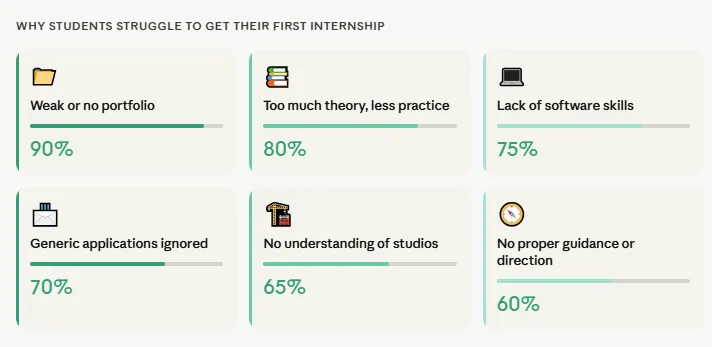
Weak or No Portfolio
Most students either do not have a portfolio or include very basic work. Studios want to see how you think, not just final images. Without strong projects, it becomes hard to stand out.
Too Much Theory, Less Practical Exposure
Colleges focus heavily on theory, but real studios expect you to understand layouts, materials, and execution. This gap makes students feel underprepared during applications and interviews.
Lack of Software Skills
Many students are not confident with tools like AutoCAD, SketchUp, or Photoshop. Even basic proficiency is expected by most firms, and this becomes a major barrier.
Generic Applications That Get Ignored
Sending the same resume and message to every studio rarely works. Designers look for intent and effort. Generic emails usually get ignored.
No Understanding of What Studios Expect
Students often assume design is only about aesthetics. But studios care about space planning, client needs, and practical solutions. This mismatch affects both applications and interviews.
Fear of Rejection or Not Feeling Ready
A lot of students delay applying because they think they are not ready yet. This slows down progress. In reality, internships are meant for learning, not perfection.
No Proper Guidance or Direction
Without the right guidance, students keep trying random approaches. They do not know where to apply, how to improve their portfolio, or how to position themselves better.
Understanding these gaps is important because once you fix these, getting your first internship becomes much more achievable.
Step-by-Step Process to Get Your First Internship
Now that you know why most students struggle, let us follow a clear and practical step by step process to help you get your first interior design internship.
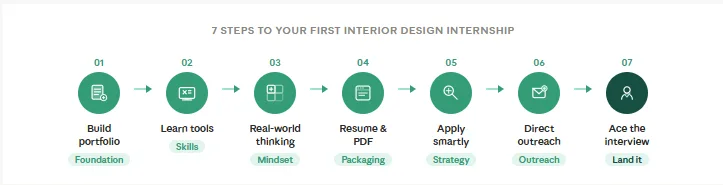
Step 1: Build a Basic but Strong Portfolio
Your portfolio is usually the first thing a studio will judge you on. If it looks weak, incomplete, or confusing, most firms will not move forward no matter how interested you are. The good part is that you do not need a huge portfolio to get your first internship. You just need a small set of projects that clearly show your thinking, your skills, and your potential.
Start with 3 to 5 good projects. These can be academic projects, self-initiated concepts, redesigns of existing spaces, or guided course projects. The focus should not be on quantity. It should be on clarity and quality. Each project should show what the brief was, what problem you were solving, how you developed the layout, and what the final outcome looked like.
A good student portfolio should usually include:
- A short project title and type of space
- The design brief or goal
- Moodboard or concept direction
- Space planning or zoning
- Layouts or furniture plans
- Basic 3D views or renders
- Material or colour direction
- Final presentation sheet
Do not just add beautiful renders and stop there. Studios want to see how you think. If your portfolio only shows polished final images, it may look decorative but not serious. Even one page showing your layout development, planning logic, or design decisions can make your work look stronger and more professional.
Step 2: Learn the Tools That Studios Actually Use
A lot of students say they know interior design, but when it comes to studio work, firms also want to know whether you can actually work with the tools used in day to day practice. You do not need to master every software before applying, but you should be comfortable with the core tools that help you draft, model, and present your ideas properly.
At a minimum, students looking for internships should aim to learn:
- AutoCAD for 2D plans, furniture layouts, dimensions, and working drawings
- SketchUp for simple 3D modelling
- Photoshop for moodboards, presentation sheets, and basic visual enhancement
- Canva or PowerPoint for clean portfolio presentation if needed
In some studios, software like Revit, V-Ray, Lumion, or Enscape may also be useful. But for your first internship, strong basics in AutoCAD, SketchUp, and Photoshop are often enough to get noticed.
What matters most is not just opening the software. It is being able to use it for actual interior design tasks.
Step 3: Work on Real-World Thinking, Not Just Pretty Designs
This is one of the biggest differences between a student who gets ignored and a student who gets selected. Many students focus only on making designs look attractive. But studios do not hire interns just for pretty visuals. They look for students who are beginning to understand how real spaces work.
You do not need to become a site expert before your first internship. But you should start thinking beyond surface beauty. Even a simple sentence in your portfolio like “The layout was planned to maintain clear movement between the bed, wardrobe, and study area” makes your work feel more professional.
Step 4: Create a Simple Resume + Portfolio PDF
Once your projects and skills are ready, the next step is packaging them properly. Many students lose opportunities because their resume is cluttered, their portfolio file is too heavy, or their presentation looks confusing. Studios are busy. They should be able to understand your profile quickly.
Start with a clean one-page resume. For internships, your resume does not need too much content. It should include:
- Full name
- Phone number
- Email address
- City
- Portfolio link if available
- Short profile summary
- Education details
- Software skills
- Key strengths
- Internship experience if any
- Relevant workshops, courses, or certifications
Your summary can be simple and direct.
For example: “Interior design student with strong interest in residential and commercial spaces. Skilled in AutoCAD, SketchUp, and Photoshop. Looking for an internship to gain practical studio exposure and improve design execution.”
Do not use generic lines like “hardworking and passionate individual seeking a challenging opportunity.” These say very little. Be specific about what you know and what you want.
Step 5: Apply Smartly, Not Randomly
Applying to internships is not only about sending as many emails as possible. It is about applying in a focused and practical way. Many students send generic messages to 100 firms and get no response. Then they assume there are no opportunities. In reality, the problem is often the approach.
Start by making a list of studios you genuinely want to work with. Do not only target big famous firms. Small and mid-size studios are often better for first internships because they give students more learning exposure and practical involvement.
Create a simple tracking sheet with:
- Studio name
- Contact person
- Email address
- Instagram or LinkedIn handle
- Date applied
- Follow-up date
- Response status
Also, be consistent. Do not apply to 5 studios one day and then stop for two weeks. Set a realistic target, like applying to 5 to 10 relevant firms every week. The students who stay consistent usually see better results than the ones who apply only once and wait.
Step 6: Reach Out Directly to Designers
Sometimes the best opportunities do not come from formal internship listings. They come from direct outreach. A lot of studios may not be actively advertising internship roles, but they may still consider a student who reaches out well.
This is why direct contact can be very effective, especially in interior design where many firms are small, founder-led, or active on visual platforms like Instagram.
Step 7: Prepare for the Internship Interview
If a studio responds positively, the next step is usually an interview, a discussion call, or a small skill test. This is where many students get nervous. The good news is that firms usually do not expect interns to know everything. They mainly want to see whether you are sincere, trainable, and clear in your basics.
The first thing you should prepare is your own work. Be ready to explain every project in your portfolio
If you cannot explain your own project clearly, it weakens trust immediately. Even if the work is simple, clear explanation can make a strong impression.
You should also be ready to answer questions like:
- Why do you want this internship?
- Why are you interested in our studio?
- Which software are you comfortable with?
- What type of projects do you enjoy working on?
- What are you currently learning?
- Are you comfortable with revisions and feedback?
- Are you willing to visit the site or support with drawings and presentations?
So go in prepared, stay calm, and focus on showing that you are serious about becoming a better designer through real studio exposure.
Further Resources:
- How to Become An Interior Designer In 7 Simple Steps
- Interior Design Course Syllabus for 2026 Batch
- 10 Best Interior Design Courses After 12th (Fees & Duration)
How ASDAV Helps You Get Internship-Ready
At ASDAV, we focus on helping students move from learning to actually becoming job ready. When students join us, they are not just learning concepts or software in isolation. Our courses are planned in a way that builds real understanding of design, tools, and practical thinking together, so that students can confidently apply for internships and start working in real studio environments.
We focus on what studios actually expect. That means working on real projects, building a strong portfolio, learning industry tools, and understanding how design decisions are made in real spaces. This approach helps students not just learn but also present themselves better and get their first opportunities faster.
Without proper guidance, many students keep learning for months but still feel unsure about how to apply, what to include in their portfolio, or how to approach studios. That gap is what we actively solve through structured learning, mentorship, and internship support.
If you are also looking to start your career in interior design, you can explore our interior design courses and certifications designed to make you industry ready. We also offer short masterclasses to help you build specific skills based on your goals, such as:
- Master in Interior Photography
- Interior Styling and Spatial Decoration
- Portfolio Development for Architecture and Interior Design
- Freehand Sketching and Drawing
- Green Building and Sustainable Design
- Landscape Design in Interior and Architecture
- Project Management in Interior Architecture
And if you are not sure where to start or what you should focus on, you can get in touch with our team for a free consultation. We will understand your current level and guide you on the right path to help you become internship ready.

Jasmine Ahluwalia is a Licensed Architect, Interior designer, Global Vastu consultant and the founder of ASDAV.
She is a graduate of Scuola Master F.lli Pesenti, Politecnico di Milano, and brings strong global exposure through academic learning and professional design projects. Her background combines architecture, interior design, and applied design education.
Before founding ASDAV, Jasmine worked as an assistant professor at Amity School of Architecture and Planning, Amity University Noida. Her research covers sustainable architecture, urban heat island reduction, and circular economy practices in construction. Her work has been published in Scopus indexed and peer reviewed journals as well. She also has strong international on-site experience from countries like Canada, Mauritius, UK, and many more.
Through ASDAV, she has trained more than 500 students across 25 cities. The ASDAV platform has 12+ instructors from IIT, SPA, CEPT and NID , and has delivered over 200 live learning sessions. Her mission is to bridge the gap between design education and real industry expectations, to deliver real growth for her students.
She designs spaces for a living, but her favourite project is designing careers.