Most people searching for a Vastu course end up in one of two places. Either they find a course so vague that it teaches nothing actionable.
Or they find one so rooted in ritual that it leaves no room for modern practice.
Neither is useful if you want actually to apply Vastu to real spaces, advise clients confidently, or add a credible Vastu specialisation to your architecture or interior design career.
A good Vastu course does not just tell you which direction the kitchen should face. It teaches you why, trains you to read any floor plan through a Vastu lens, and shows you how to suggest remedies that work without tearing walls down.
At ASDAV, our online vastu shastra course is built on exactly this principle.
It is a structured, 6-week applied programme rated 4.9 out of 5 by over 520 students, taught by Jasmine Ahluwalia, a licensed architect with a master’s degree from Politecnico di Milano and a practising global Vastu consultant.
In this guide, we break down what a comprehensive Vastu course syllabus should cover, what separates applied learning from surface-level theory, and how to decide if you are ready to invest in Vastu as a professional skill.
👉 Download the full Vastu Course Syllabus
What is Vastu Shastra?
Vastu Shastra (Sanskrit: वास्तु शास्त्र) is an ancient Indian system of architecture that establishes principles for designing, arranging, and orienting built spaces in alignment with natural forces, directional energies, and the five classical elements..
The word Vastu comes from the Sanskrit root meaning dwelling or site, and Shastra means science or teaching. Together, they refer to the science of construction and spatial arrangement. Vastu Shastra is part of the Vedic knowledge tradition and draws from foundational texts including the Manasara, the Mayamata, the Brihat Samhita by Varahamihira (6th century CE), and the Samarangana Sutradhara.
The Manasara, for example, is organised into 70 chapters and approximately 10,000 shlokas (verses) covering everything from site selection and building measurement to proportional systems for temples and residential structures.
Vastu Shastra is not a set of superstitions. It is a systematic framework that connects directional orientation, elemental balance, spatial proportion, and energy flow with the lived experience of the people inside a building. The five elements at the core of Vastu are:
- Bhumi (Earth): Stability, support, weight-bearing — applies to plot selection, foundation, and material choices
- Jal (Water): Flow, purification, movement — governs placement of water bodies, plumbing, and drainage
- Agni (Fire): Energy, heat, transformation — guides kitchen placement, electrical installations, and fire-related zones
- Vayu (Air): Circulation, ventilation, breath — informs window placement, cross ventilation, and openings
- Akasha (Space): The Brahmasthan or central void — the energetic core of any structure that must remain open and unobstructed
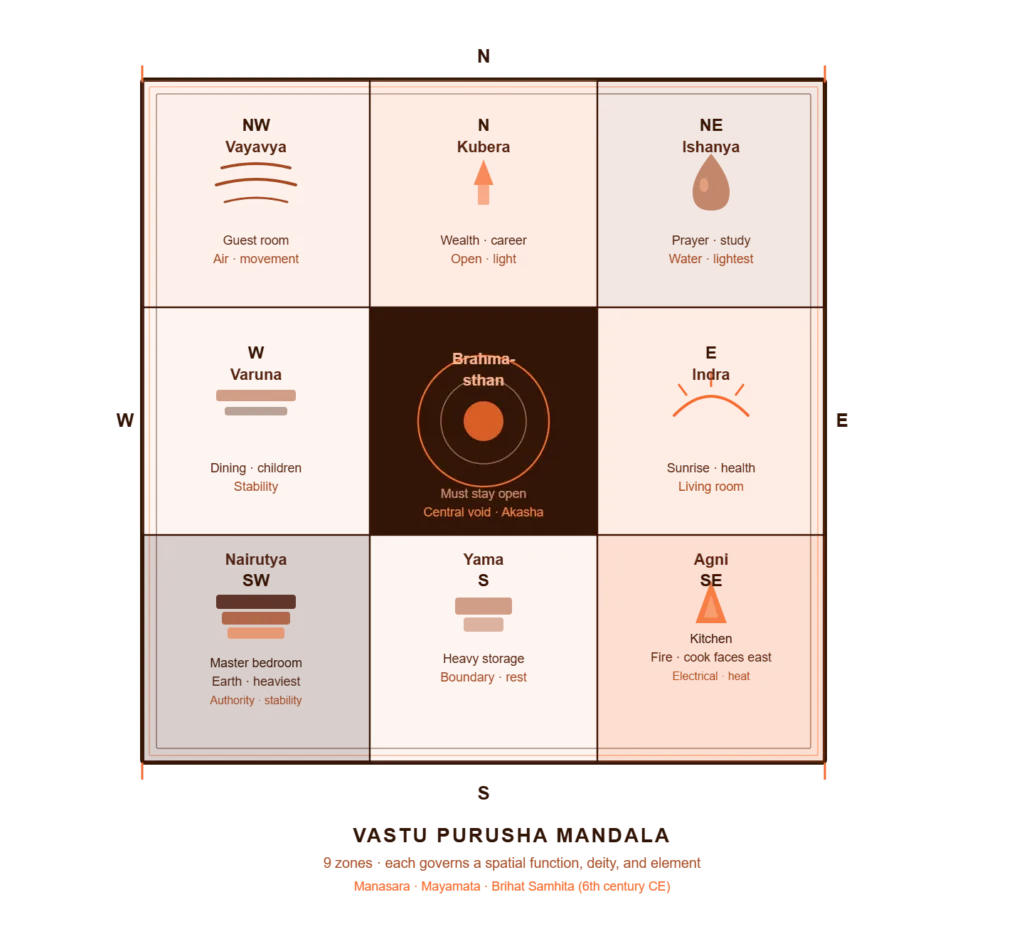
These five elements are mapped onto a grid called the Vastu Purusha Mandala, a square diagram that overlays a human figure onto the site plan. Each zone in the mandala corresponds to a direction, a deity, a planet, an element, and a recommended use. This grid is the technical tool at the centre of classical Vastu analysis.
📌 Quick fact:
Vastu Shastra gained significant prominence during the Gupta period (320 to 550 CE) when it was extensively applied to the construction of temples and palaces. Its classical texts predate modern urban planning by more than a thousand years.
Why Vastu is a Viable Professional Skill in 2026
Vastu is no longer a niche interest. It has moved from being a personal preference to a professional requirement across real estate, architecture, and interior design.
Here is what is driving demand for trained Vastu professionals right now:
- Real estate compliance: A growing number of real estate developers and builders actively market Vastu-compliant layouts as a selling point for residential projects. Buyers ask for Vastu reports before purchase decisions.
- Architect and designer add-ons: Practising architects and interior designers who can offer Vastu consultation as part of their service expand their offering and command higher fees without adding major overhead.
- Industrial and commercial demand: Factory owners, office developers, and retail chains increasingly commission Vastu assessments to improve workflow, productivity, and spatial harmony in their workplaces.
- Client-driven requirement: In India and across the Indian diaspora in the UAE, USA, UK, Canada, and Australia, clients regularly request Vastu guidance before any renovation or new construction project.
- Non-demolition remedies: Modern Vastu practice focuses heavily on solutions that require no structural changes. This makes the service accessible and affordable for existing buildings, widening the potential client base significantly.
According to EducationWorld, as India experiences a sustained real estate boom, demand for trained Vastu professionals is growing steadily, and most people enrolling in structured Vastu courses are qualified architects, civil engineers, and interior designers looking to add this specialisation to their practice.
What a Good Vastu Course Syllabus Should Cover
Before you enrol in any Vastu course, the single most important thing to examine is the syllabus. A well-structured Vastu syllabus moves from foundational principles to applied practice in a logical sequence.
Here is what every credible course should include:
| Week | Focus Area | What You Learn |
|---|---|---|
| Week 1 | Foundations of Applied Vastu | The five elements (Panchabhutas) and their spatial roles. Eight and sixteen directional zones. The Vastu Purusha Mandala: structure, mapping, and application. The scientific basis behind directional orientation. How Vastu principles interact with sunpath, wind, and magnetic field. Introduction to Vastu defects (doshas) and non-demolition remedies. |
| Week 2 | Residential Vastu Principles | Room-by-room directional guidelines: bedroom, kitchen, puja room, study, bathroom, locker room. Main entrance placement and its energy implications. Color, lighting, and spatial arrangement as per Vastu. Vastu for multi-storey residential buildings. Common residential defects and practical remedies without structural changes. |
| Week 3 | Industrial and Commercial Vastu | Vastu for office spaces: cabin placement, workstation layout, pantry, toilet zones. Production floor orientation and machine placement for industrial settings. Energy zoning for warehouses and factories. Applying Vastu in commercial retail, showrooms, and hospitality spaces. Improving employee productivity and business flow through spatial correction. |
| Week 4 | Case Studies and Real-Time Application | Analysing real residential and industrial Vastu layouts. Identifying defects and proposing practical, non-structural remedies. Hands-on live case solving with expert feedback. Client scenario simulation and communication practice. Building confidence for real-world Vastu consultation. |
This is exactly the structure followed in ASDAV’s Art of Applied Vastu: Residential and Industrial course. The 6-week programme is designed so that by the final week, students are not just reading about Vastu. They are solving real cases, getting expert feedback, and practising client-facing communication.
🎓 Course highlight:
ASDAV’s Vastu course includes 20+ real-life case studies, one-on-one sessions, cohort group discussions, and comprehensive courseware. Rated 4.9 out of 5 by over 520 students. Next batch starts 20th April 2026.
Vastu Course Syllabus: Week-by-Week Breakdown
Let us go deeper into each week of a structured Vastu course so you know exactly what to expect and why each module matters.
Week 1: Introduction to Applied Vastu
This is where solid Vastu training separates itself from surface-level content. The first week should do more than define what Vastu is. It should establish the analytical framework you will use throughout your practice.
The Panchabhutas (five elements) are the foundation of all Vastu analysis. Each element governs a directional zone and a spatial function. Confusing these zones, or treating them as interchangeable, is the most common error made by people who learn Vastu from scattered online content rather than a structured course.
The Vastu Purusha Mandala is the grid that makes directional analysis precise. It divides a site or floor plan into 81 squares (a 9×9 grid), each associated with a specific energy, deity, and function. Understanding how to map this grid onto any plot or building plan is a non-negotiable skill for professional Vastu practice.
Week 1 also covers the scientific reasoning behind Vastu orientations. The east is the direction of sunrise, which drives passive solar design. The northeast zone (Ishanya) corresponds to the lightest corner of a building and governs prayer and study spaces. The southwest (Nairutya) is the heaviest zone and correctly houses the master bedroom, storage, and structural load. These correspondences are not arbitrary. They reflect relationships between solar movement, magnetic field, airflow, and human biological rhythms.
- Understand the Panchabhutas and their spatial roles
- Map the Vastu Purusha Mandala onto any floor plan
- Read the 8 and 16 directional zones with accuracy
- Identify types of Vastu doshas and their effects
- Understand what non-demolition remedies are and how they work
Week 2: Residential Vastu Principles
Week 2 is where most students find the clearest connection between theory and practice. Residential Vastu covers the room-by-room directional rules that affect daily living.
Here are the core areas any residential Vastu curriculum must address:
Main Entrance (Dwara)
The entrance is the primary point of energy flow into the home. North, east, and northeast-facing entrances are generally considered most auspicious because they receive morning light and align with positive solar and magnetic energy. The specific sub-direction within a zone (of the 32 sub-divisions used in advanced Vastu) determines the quality of energy entering the space.
Kitchen (Agni Zone)
The kitchen belongs to the fire element and should ideally be placed in the southeast zone (Agni corner) of the home. The cook should face east while cooking. Placing the kitchen in the northeast or north, which are water-element zones, creates an elemental conflict that Vastu identifies as a source of chronic health or financial instability for occupants.
Master Bedroom
The southwest zone is governed by the earth element and is the heaviest, most stable corner of the floor plan. The master bedroom belongs here. Sleeping with the head oriented to the south or east aligns with Earth’s magnetic field, which runs north to south. Head towards the north places the body in the same polarity as the north magnetic pole, which Vastu and some studies on geomagnetic effects on sleep associate with poor rest.
Brahmasthan (Central Zone)
The Brahmasthan is the central portion of any floor plan, roughly the central 1/9th of the total area. This zone must remain unobstructed. Heavy columns, staircases, toilets, or storage placed in the Brahmasthan are among the most serious Vastu defects because they block the spatial energetic core of the building.
Color and Lighting
Colors carry elemental associations in Vastu. Warm colors (yellows, oranges) in the southeast, cool greens and blues in the north and northeast, earthy tones in the southwest. Light must be adequate and directionally aligned. Dim northeast zones and excessively bright southwest zones create elemental imbalance.
💡 Applied insight:
One of the most common residential Vastu defects is a toilet in the northeast or a kitchen in the north. Both create elemental conflicts. In ASDAV’s course, students learn to identify these defects in any floor plan and recommend practical, cost-free or low-cost remedies.
Week 3: Industrial and Commercial Vastu
This is the module that most Vastu courses skip or handle superficially. Industrial and commercial Vastu is where professional demand is highest and where the financial impact of good Vastu practice is most directly visible.
Industrial spaces have different energy requirements than residential ones.
The priority shifts from personal wellbeing to productivity, workflow, safety, and business growth. Here is what a strong Week 3 curriculum covers:
- Office layout and cabin placement: The owner or senior management’s cabin should ideally occupy the southwest zone, which represents authority and stability. Facing north or east while working aligns with productive directional energy.
- Production and machine placement: Heavy machinery belongs in the south and southwest. Lighter processes and quality control work well in the north and east. Raw material storage works in the southwest and west zones.
- Main gate and reception: Industrial unit entrances in the north, northeast, or east are preferred. The reception counter placed in the northeast creates a welcoming energy flow for visitors and clients.
- Toilet and pantry zones: These are placed in the northwest or south, away from the northeast, east, and Brahmasthan. Poor placement of service areas is one of the most frequent industrial Vastu defects found in practice.
- Workflow and movement paths: Materials should ideally move from south and west (storage) toward north and east (output and dispatch). Circular or clockwise movement in production areas aligns with Vastu’s directionality principles.
Week 4: Case Studies and Real-Time Problem Solving
The difference between a student who understands Vastu and a professional who can practise it lies entirely in this fourth week. This is where applied learning consolidates into professional confidence.
Week 4 should not be a lecture. It should be a workshop. Students should receive real floor plans (residential and industrial), identify defects using the tools from Weeks 1 to 3, propose prioritised remedies, and then defend their reasoning in group discussion and expert feedback sessions.
This module builds three things that no amount of reading can substitute:
- Speed of analysis: Reading a plan and forming a Vastu assessment quickly, the way a working consultant must
- Communication skill: Explaining Vastu findings and remedies to a client in plain language, without jargon or fear-mongering
- Confidence under uncertainty: Real sites rarely present perfect Vastu conditions. Learning to prioritise the most critical defects and propose practical solutions within client constraints is the mark of an experienced practitioner
In ASDAV’s Vastu course, Week 4 includes group discussions, live site examples, expert-led feedback sessions, and one-on-one guidance to ensure that every student finishes the course ready to consult, not just to study.
What to Look for in a Vastu Course Before You Enrol
Not every Vastu course is worth your time or money. Before you commit, check for these markers of a credible, applied programme:
Taught by a practitioner, not just a theorist
The instructor should have real Vastu consultation experience, not just academic familiarity with the texts. Ask whether they have worked on residential and commercial projects. Applied knowledge looks different from classroom knowledge.
Covers industrial and commercial Vastu, not just residential
Most amateur Vastu courses cover only residential spaces because residential content is easier to produce. Industrial and commercial Vastu requires deeper knowledge of workflow, spatial zoning, and business environment. If the course you are considering stops at home Vastu, its scope is limited.
Includes live case study analysis
A course that ends at Week 3 without a real practice session produces students who know the theory but cannot apply it. Insist on live case solving as part of the curriculum.
Teaches non-demolition remedies
Almost every client who comes to a Vastu consultant is living or working in an existing structure. The ability to identify defects and propose remedies without structural changes is the most commercially valuable skill in modern Vastu practice.
Has a clear week-by-week curriculum
If a course cannot show you a clear, structured week-by-week syllabus, that is a warning sign. Professional education is planned education. Vague content descriptions usually indicate vague teaching.
✅ ASDAV’s Vastu course covers all five of these markers.
6 weeks. Week-by-week curriculum. 20+ case studies. Non-demolition remedies. Expert-led feedback. Taught by Jasmine Ahluwalia, a licensed architect and practising Vastu consultant with international project experience.
Who Should Take a Vastu Shastra Course?
Vastu training is not only for people who plan to practise as dedicated consultants. Here is who genuinely benefits from a structured Vastu course:
- Architects and interior designers: Add Vastu as a value-added service to existing projects. Many clients ask for this and are willing to pay a premium for it. If you cannot provide it, they will find someone who can.
- Real estate professionals: Developers, agents, and property consultants who understand Vastu can advise clients better and position Vastu-compliant properties more effectively during sales.
- Homeowners planning renovation: Understanding basic Vastu principles before a renovation helps you make better placement decisions. You do not need a consultant for every decision if you understand the framework.
- Entrepreneurs and business owners: The spatial arrangement of your office or factory affects how your team works and how clients perceive your business. Industrial Vastu is a practical tool, not a ritual.
- Career changers: Vastu consultation is a viable independent career that combines traditional knowledge with practical spatial problem-solving. The barrier to entry is lower than architecture or interior design, but the demand is comparable.
- Educators and academics: Vastu has a rich scholarly tradition through texts like the Manasara and Mayamata. Academics and researchers studying Indian architectural history, urban planning, or traditional knowledge systems will find formal Vastu training a useful context for their work.
Learn Vastu the Applied Way Through ASDAV
There are many places online where you can read about Vastu. There are not many where you can actually learn to practise it.
ASDAV’s Art of Applied Vastu: Residential and Industrial course is designed specifically for people who want to take Vastu beyond theory. It is not a lecture series. It is a structured, 6-week applied programme that moves from foundational principles to live case solving, with expert guidance, group discussions, and one-on-one sessions throughout.
Here is what you get when you enrol:
- Week 1: Core principles, the Vastu Purusha Mandala, Panchabhutas, and directional zones
- Week 2: Full residential Vastu curriculum, room by room, with color and lighting applications
- Week 3: Industrial and commercial Vastu with production floor and office space guidance
- Week 4: Live case study analysis, real site solving, and expert-led feedback sessions
- 20+ real-life case studies throughout the course
- One-on-one sessions and cohort group discussions
- Comprehensive courseware and a certification upon completion
- Taught by Jasmine Ahluwalia, Licensed Architect, Politecnico di Milano graduate, and practising global Vastu consultant
🎓 Ready to learn Vastu the way practitioners actually use it?
Enrol in ASDAV’s Art of Applied Vastu: Residential and Industrial course. 6 weeks. 20+ real-life case studies. Expert mentorship. Certification included. Next batch: 20th April 2026.
💡 Related Resources from ASDAV
- Art of Applied Vastu: Residential and Industrial (6-Week Course)
- A Beginners Course For Vastu Shastra
- Design with Direction: A Vastu Masterclass
- How to Become a BIM Modeler: A Complete Guide
- All Architecture and Design Courses at ASDAV
Frequently Asked Questions
What is covered in a Vastu course syllabus?
A comprehensive Vastu course syllabus covers the five elements (Panchabhutas), the eight and sixteen directional zones, the Vastu Purusha Mandala, residential Vastu principles room by room, industrial and commercial Vastu, color and lighting guidance, types of Vastu defects (doshas), and non-demolition remedies. Applied courses also include live case study analysis and real site problem solving. The ASDAV Vastu course covers all of these across a structured 4-week programme.
Can an architect or interior designer benefit from a Vastu course?
Yes, significantly. Architects and interior designers who understand Vastu can offer it as an integrated service during the design phase, which is far more valuable than a bolt-on consultation after the design is complete. Clients in India and across the Indian diaspora frequently request Vastu guidance, and professionals who can provide it confidently expand their service offering without adding major overhead. The ASDAV Vastu course is specifically designed for design and architecture professionals who want to apply Vastu in their practice.
Is Vastu Shastra scientifically valid?
Vastu Shastra is a traditional system grounded in directional orientation, elemental balance, and spatial proportion that has been codified in texts like the Manasara and Mayamata over many centuries. Many of its core spatial principles align with passive solar design, natural ventilation strategy, and environmental psychology. Its claims about energy flow and wellbeing outcomes are not uniformly verified through controlled scientific studies, and Vastu should be understood as a traditional design framework rather than a clinical science. That said, its practical spatial guidelines for orientation, room placement, and elemental zoning have demonstrable logic when examined against solar movement, wind patterns, and human behavioural research.
Do I need a design or architecture background to learn Vastu?
No, a formal architecture background is not required to learn Vastu. However, a basic ability to read floor plans and understand spatial layouts will help you get more out of the course faster. ASDAV’s Vastu course is open to architects, interior designers, real estate professionals, homeowners, entrepreneurs, and anyone interested in applying Vastu to residential or commercial spaces.
How long does it take to complete a Vastu course?
The ASDAV Art of Applied Vastu course is a 4-week structured programme. This is designed to be intensive enough to build real skill without being stretched out over months. By the end of Week 4, students have completed live case study analysis and are ready to apply Vastu in real residential and industrial projects.
What can I do after completing a Vastu course?
After completing a structured Vastu course, you can offer Vastu consultation as a standalone service or as an add-on to your existing architecture, interior design, or real estate practice. You can advise homeowners during renovation or new construction, provide industrial and commercial Vastu assessments to business owners, and work with property developers on Vastu-compliant project planning. T
he non-demolition remedy skills you learn also allow you to advise clients in existing buildings without requiring structural changes, which significantly broadens the range of people you can help.

Jasmine Ahluwalia is a Licensed Architect, Interior designer, Global Vastu consultant and the founder of ASDAV.
She is a graduate of Scuola Master F.lli Pesenti, Politecnico di Milano, and brings strong global exposure through academic learning and professional design projects. Her background combines architecture, interior design, and applied design education.
Before founding ASDAV, Jasmine worked as an assistant professor at Amity School of Architecture and Planning, Amity University Noida. Her research covers sustainable architecture, urban heat island reduction, and circular economy practices in construction. Her work has been published in Scopus indexed and peer reviewed journals as well. She also has strong international on-site experience from countries like Canada, Mauritius, UK, and many more.
Through ASDAV, she has trained more than 500 students across 25 cities. The ASDAV platform has 12+ instructors from IIT, SPA, CEPT and NID , and has delivered over 200 live learning sessions. Her mission is to bridge the gap between design education and real industry expectations, to deliver real growth for her students.
She designs spaces for a living, but her favourite project is designing careers.